Most Agencies Think Their Problem Is Capacity
When deadlines start slipping and projects begin piling up, agency leaders often reach the same conclusion:
"We need more people."
So they hire.
Another designer.
Another account manager.
Another project coordinator.
For a few months, things improve.
Then the same problems return:
Projects still get delayed.
Revisions still pile up.
Teams still feel overwhelmed.
Clients still chase updates.
The agency grows.
The chaos grows with it.
Because the real problem wasn't capacity.
It was workflow.
And workflow bottlenecks have a nasty habit of hiding in plain sight.
The Most Dangerous Bottlenecks Are Invisible
When a designer misses a deadline, everyone notices.
When a client complains, everyone notices.
When a campaign launches late, everyone notices.
But workflow bottlenecks are different.
They're small.
Repeated.
Almost invisible.
Individually, they don't seem significant.
Collectively, they can consume hundreds of hours every month.
The challenge is that agencies often measure outputs.
They rarely measure friction.
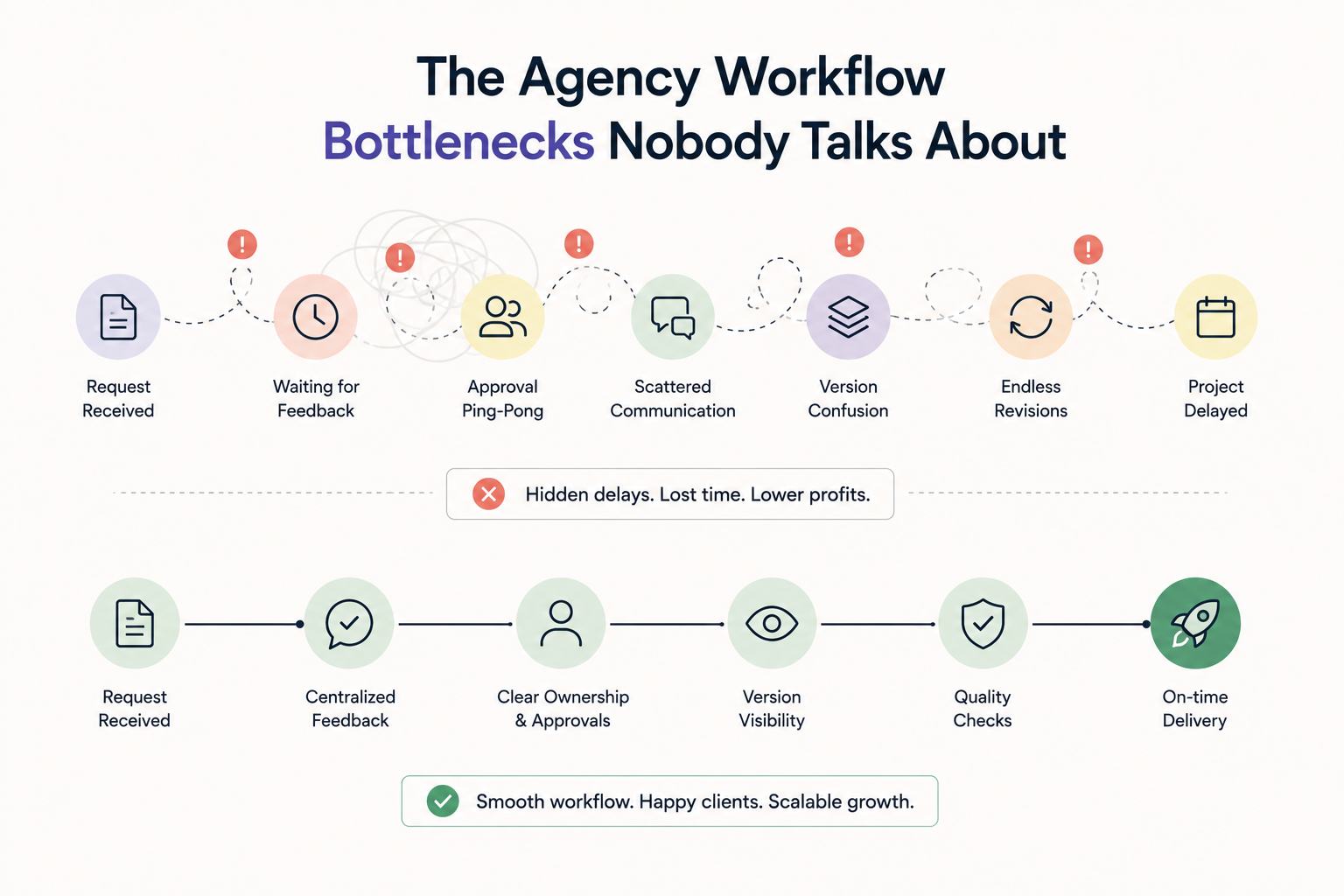
Bottleneck #1: Waiting for Feedback
This is arguably the most expensive bottleneck in creative operations.
A designer completes work.
The client needs to review it.
The file gets sent.
And then...
Nothing.
The project enters limbo.
Hours become days.
Days become weeks.
Meanwhile:
Resources remain allocated.
Timelines become uncertain.
New projects can't move forward.
The designer isn't working.
The client isn't deciding.
The project is simply waiting.
Waiting is one of the least visible but most expensive activities inside agencies.
Bottleneck #2: Approval Ping-Pong
Many agencies unknowingly create approval loops.
The process looks like:
Designer → Account Manager → Client → Marketing Team → Director → Founder
Then back again.
Each handoff introduces:
Delays
Miscommunication
Context loss
Additional revisions
The actual design work may take three hours.
The approval journey may take three weeks.
Bottleneck #3: Feedback Translation
Clients speak business.
Designers speak design.
Project managers speak process.
Somewhere between these conversations, feedback gets translated.
Sometimes incorrectly.
For example:
Client says:
"The page doesn't feel trustworthy."
The message reaches the designer as:
"Increase the logo size."
The original problem disappears.
The symptom remains.
This creates unnecessary revision cycles that could have been avoided through clearer communication.
Bottleneck #4: Context Switching
Most agencies don't have a workload problem.
They have an attention problem.
A designer works on:
Project A
Switches to Project B
Responds to feedback on Project C
Joins a meeting for Project D
Reviews revisions for Project E
The day feels productive.
In reality, context switching is one of the largest hidden productivity killers.
Every switch requires mental reloading.
The brain spends time remembering:
Objectives
Decisions
Stakeholders
Constraints
The work doesn't stop.
The momentum does.
Bottleneck #5: Version Confusion
Every agency has experienced this conversation:
"Wait... which version are we reviewing?"
Version confusion creates:
Duplicate work
Incorrect feedback
Missed approvals
Frustrated stakeholders
The larger the team, the more expensive version confusion becomes.
When people review outdated files, entire review cycles become meaningless.
Bottleneck #6: Meeting Dependency
Many agencies accidentally create workflows that require meetings for everything.
Need approval?
Schedule a meeting.
Need clarification?
Schedule a meeting.
Need feedback?
Schedule a meeting.
Soon calendars become more crowded than project boards.
The irony is that meetings often exist because information isn't accessible elsewhere.
Meetings become a workaround for broken workflows.
Bottleneck #7: Scattered Communication
Feedback lives in:
Email
WhatsApp
Slack
PDFs
Google Docs
Zoom recordings
No single person has the complete picture.
Every stakeholder sees a different version of reality.
The agency spends more time searching for information than acting on it.
This creates one of the biggest hidden costs in operations:
Information retrieval.
Bottleneck #8: Endless Revision Loops
Many agencies believe revisions are part of the job.
That's true.
But endless revisions usually indicate a workflow issue.
Common causes include:
Undefined objectives
Late stakeholder involvement
Unclear approval processes
Poor feedback quality
The problem isn't the revision itself.
The problem is why the revision exists.
Bottleneck #9: Quality Control Happens Too Late
Many agencies review quality only before delivery.
That's risky.
By that point:
Stakeholders are waiting.
Timelines are tight.
Pressure is high.
Errors discovered late are significantly more expensive to fix.
A typo found during concept review takes minutes.
The same typo discovered after approval can trigger an entire revision cycle.
Bottleneck #10: Project Ownership Ambiguity
Ask three people:
"Who owns this project?"
And you'll sometimes get three different answers.
Ownership confusion creates:
Delayed decisions
Accountability gaps
Duplicate communication
Slower execution
High-performing agencies eliminate ambiguity.
Every project has a clearly defined owner.
Always.
The Real Cost of Workflow Bottlenecks
Most agencies measure:
Revenue
Utilization
Billable hours
Few measure operational friction.
Yet workflow bottlenecks affect:
Profitability
More delays mean higher delivery costs.
Capacity
Teams appear busy but accomplish less.
Client Experience
Clients perceive inefficiency.
Team Morale
Repeated friction creates frustration.
Growth
Operations become harder to scale.
Why Hiring Doesn't Fix Workflow Problems
Many agency leaders assume:
"If we hire more people, things will improve."
Sometimes they do.
Temporarily.
But adding people to a broken workflow often creates:
More communication
More meetings
More approvals
More complexity
The bottleneck simply moves elsewhere.
This is why some agencies double team size but experience little improvement in delivery speed.
The Rise of Operational Thinking in Agencies
The most successful agencies are no longer thinking only about creativity.
They're thinking about systems.
They understand that great work depends on:
Efficient reviews
Clear approvals
Centralized feedback
Quality control
Process visibility
Workflow is becoming a competitive advantage.
Not just an operational necessity.
How High-Performing Agencies Remove Bottlenecks
1. Create a Single Source of Truth
Every project should have one location for:
Feedback
Approvals
Versions
Decisions
No searching required.
2. Reduce Approval Layers
Every additional approver adds delay.
Limit approvals to essential decision-makers.
3. Centralize Feedback
Scattered comments create confusion.
Many agencies now use dedicated creative review platforms such as Revue to centralize annotations, approvals, version tracking, and stakeholder collaboration.
The result is less friction and faster decision-making.
4. Build Quality Control Into the Workflow
Don't wait until delivery.
Quality checks should occur throughout the project lifecycle.
5. Measure Waiting Time
Most agencies measure work time.
Elite agencies also measure waiting time.
Because delays often reveal workflow bottlenecks faster than productivity metrics.
What Elite Agencies Understand
Top-performing agencies know something many agencies overlook:
Creative excellence alone doesn't create scalable operations.
Systems do.
Every workflow contains bottlenecks.
The difference is that great agencies actively identify and remove them.
Because growth isn't limited by talent.
Growth is limited by process.
Conclusion
The biggest workflow bottlenecks inside agencies rarely appear on project plans.
They're hidden inside:
Waiting
Approvals
Feedback
Meetings
Communication
Revisions
Individually, they seem small.
Collectively, they determine whether an agency scales smoothly or struggles constantly.
The agencies that grow profitably aren't always the most creative.
They're often the most operationally disciplined.
Because every bottleneck removed creates more time, more capacity, and more opportunity for great work to happen.
Frequently asked questions
What are agency workflow bottlenecks?
Workflow bottlenecks are delays, inefficiencies, or process constraints that slow project delivery and reduce productivity.
Why do creative agencies struggle with bottlenecks?
Common causes include delayed feedback, excessive approvals, version confusion, scattered communication, and unclear ownership.
How do workflow bottlenecks affect profitability?
They increase delivery costs, consume team capacity, create revision loops, and delay project completion.
What's the biggest bottleneck in most agencies?
Waiting for client feedback and approvals is often the largest source of operational delay.
How can agencies improve workflow efficiency?
By centralizing feedback, reducing approval layers, improving project ownership, and implementing structured review processes.