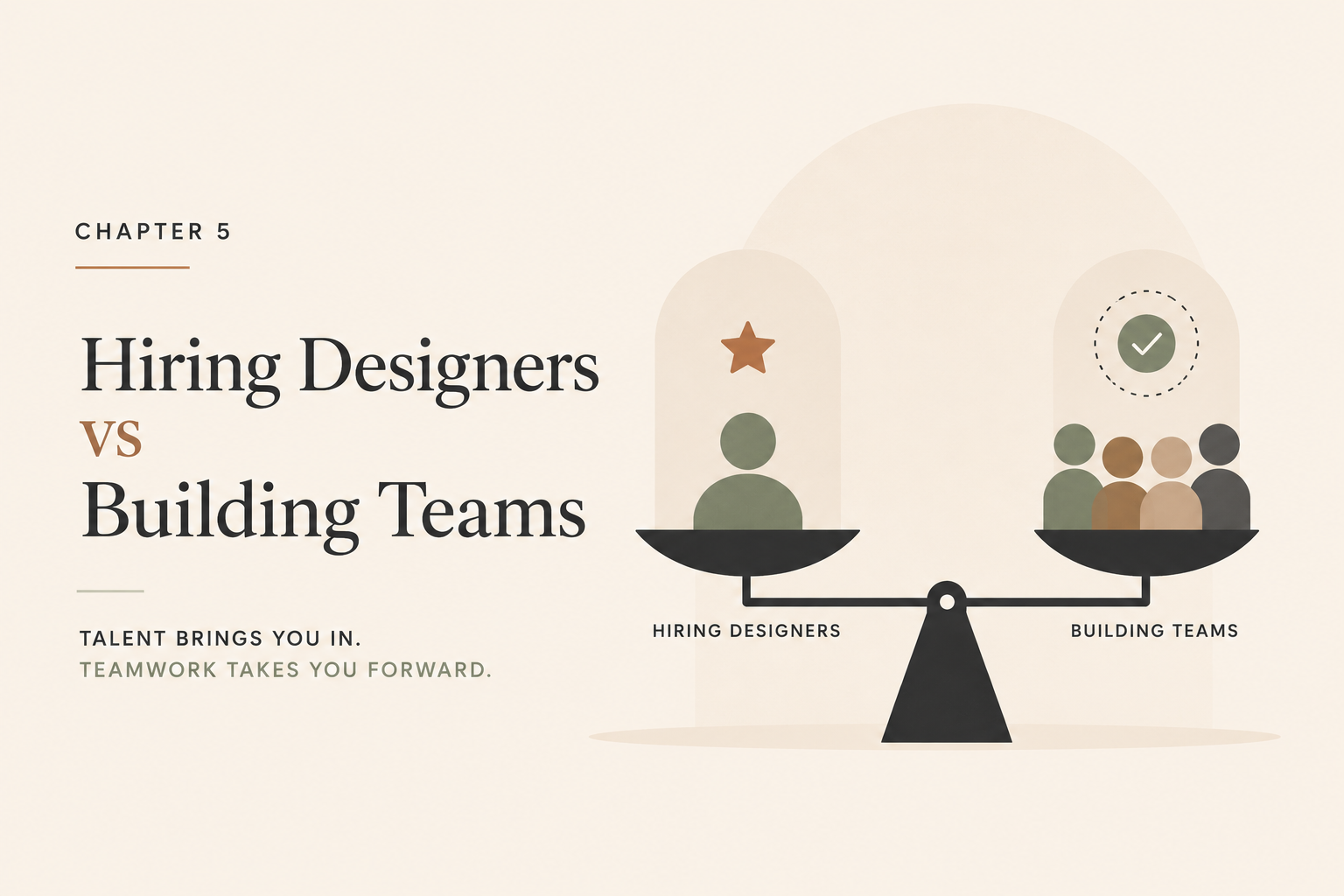
Most agency founders believe growth happens by hiring more designers.
A new client arrives.
Workload increases.
The solution seems obvious:
"Let's hire another designer."
But over time, many agencies discover a frustrating reality.
Despite hiring talented people, projects still get delayed.
Communication remains messy.
Quality becomes inconsistent.
Clients become harder to manage.
And growth feels more difficult than expected.
The problem isn't the designers.
The problem is confusing individual talent with team capability.
Because hiring designers and building teams are two very different things.
The Talent Trap
Many creative agencies hire based primarily on portfolios.
The logic is understandable.
A strong portfolio demonstrates:
Creative ability
Technical skill
Visual thinking
Craftsmanship
But agencies rarely fail because of a lack of creative talent.
They struggle because talented individuals cannot automatically function as an effective team.
A group of excellent designers does not necessarily create excellent outcomes.
Just as a collection of talented musicians doesn't automatically become a great orchestra.
Why Individual Talent Doesn't Scale
In small teams, communication happens naturally.
Everyone knows:
Project status
Client expectations
Priorities
Deadlines
As agencies grow, informal communication begins to break down.
What worked with three people often fails with ten.
Soon, problems emerge:
Duplicate work
Missed feedback
Version confusion
Inconsistent quality
Delayed approvals
These are not talent problems.
They are team structure problems.
The Difference Between Hiring and Team Building
Hiring Designers
Focuses on:
Individual skills
Creative portfolios
Software proficiency
Design expertise
Building Teams
Focuses on:
Collaboration
Accountability
Communication
Shared processes
Collective outcomes
One improves capability.
The other improves scalability.
The most successful agencies invest in both.
Why High Performers Don't Always Create High-Performing Teams
One common mistake is assuming the strongest designer should automatically lead others.
Technical excellence and leadership are different skills.
Great team builders excel at:
Coaching
Communication
Delegation
Conflict resolution
Process improvement
A designer may be exceptional at creating work while struggling to manage people.
Promotions based solely on creative ability often create management challenges.
The Hidden Costs of Weak Teams
When team structures are unclear, agencies experience operational friction.
Knowledge Silos
Critical information remains trapped with specific individuals.
Projects slow down when those individuals are unavailable.
Inconsistent Quality
Every designer follows a different process.
Deliverables become unpredictable.
Clients notice the inconsistency.
Excessive Reviews
Managers spend more time correcting work because expectations are unclear.
Review cycles become longer.
Burnout
Top performers compensate for weak systems.
Eventually, they become overloaded.
What Great Creative Teams Have in Common
The best agencies don't rely on hero designers.
They build systems that allow teams to perform consistently.
Clear Roles and Responsibilities
Everyone understands:
What they own
What they contribute
Who makes decisions
This reduces confusion and increases accountability.
Shared Quality Standards
High-performing teams define what "good" looks like.
This includes:
Design quality
File organization
Brand consistency
Delivery standards
Quality becomes systematic rather than individual.
Structured Feedback
Feedback follows a defined process.
Comments are centralized.
Reviews are documented.
Decisions are visible.
This minimizes misunderstandings and accelerates collaboration.
Strong Communication Frameworks
Successful teams reduce dependency on meetings and scattered conversations.
Information becomes accessible, searchable, and organized.
Why Culture Alone Isn't Enough
Many agencies talk about culture.
Fewer invest in operational systems.
Culture matters.
But culture without structure creates ambiguity.
Strong teams require:
Expectations
Accountability
Processes
Measurement
Great culture amplifies strong systems.
It cannot replace them.
The Role of Creative Operations
As agencies scale, creative operations become increasingly important.
Creative operations help teams manage:
Workflow consistency
Resource allocation
Project visibility
Review cycles
Quality assurance
This allows designers to spend more time creating and less time navigating chaos.
Building Teams That Scale
Agency growth becomes sustainable when founders stop asking:
"Who should we hire next?"
and start asking:
"How can our team work better together?"
The answer often involves:
Standardized Workflows
Reducing dependency on individual habits.
Better Knowledge Sharing
Making information accessible across the organization.
Defined Review Processes
Creating consistency in feedback and approvals.
Improved Quality Control
Preventing errors before they create rework.
Leadership Development
Teaching managers how to build teams rather than simply manage tasks.
Why Team Building Improves Profitability
Stronger teams don't just improve culture.
They improve business performance.
Benefits include:
Faster project delivery
Lower revision rates
Improved client satisfaction
Reduced rework
Higher team retention
Better profit margins
The financial impact of strong teams is often larger than the impact of hiring additional talent.
The Future of Creative Agencies
The agencies that scale successfully will not necessarily have the most talented individuals.
They will have the strongest teams.
Because creative work today requires:
Collaboration
Coordination
Communication
Quality control
Operational excellence
Talent remains essential.
But sustainable growth comes from building systems that allow talent to thrive together.
Conclusion
Hiring designers solves short-term capacity problems.
Building teams solves long-term growth problems.
Agencies that focus solely on recruiting talent often find themselves struggling with communication issues, inconsistent quality, and operational complexity.
The most successful agencies recognize that talent creates potential, but teams create results.
Because great agencies aren't built by individuals.
They're built by people who know how to work together.
Frequently asked questions
1. What is the difference between hiring designers and building teams?
Hiring designers focuses on adding individual skills and creative talent. Building teams focuses on collaboration, communication, accountability, and creating systems that allow people to work effectively together.
2. Why do talented designers sometimes struggle in teams?
Strong design skills do not automatically translate into teamwork, communication, leadership, or collaboration abilities. Team performance depends on shared processes and alignment, not just individual talent.
3. How can agencies build stronger creative teams?
Agencies can build stronger teams by establishing clear roles, standardizing workflows, improving feedback systems, creating quality standards, and investing in leadership development.
4. Why is team building important for agency growth?
As agencies grow, communication and coordination become more complex. Strong teams help maintain quality, improve efficiency, reduce rework, and enable sustainable scaling.
5. How does team structure affect profitability?
Effective team structures reduce operational inefficiencies, improve project delivery speed, minimize revision cycles, and increase client satisfaction, all of which contribute to higher profit margins.