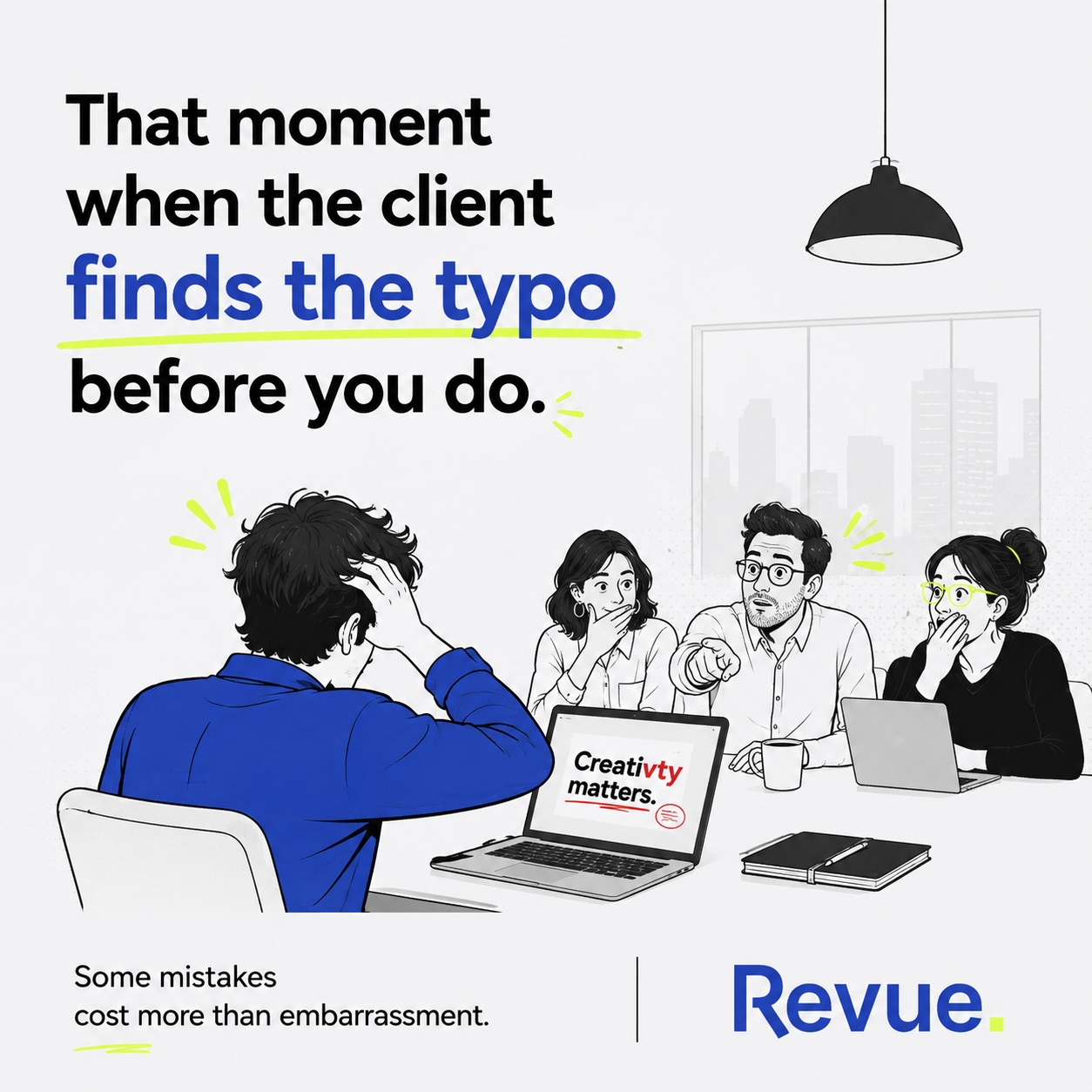
Most agencies think client retention is mainly about results, relationships, and responsiveness.
And yes, those things matter.
If the work performs, if the team communicates well, and if the relationship feels smooth, clients usually stay longer. That’s the common logic.
But there’s another retention killer that agencies often underestimate because it doesn’t always explode immediately.
Design errors.
Not just the obvious catastrophic mistakes. The smaller ones too:
a typo in a social campaign
inconsistent spacing in a presentation
the wrong logo variation in a key asset
outdated copy in a resized banner
a CTA missing from one export
a visual hierarchy issue that should have been caught before delivery
a deck shared with alignment problems or incorrect brand styling
Any one of these may seem minor in isolation. Sometimes the client even corrects it casually and moves on.
That’s exactly why agencies misread the danger.
Because design errors don’t always destroy retention through one dramatic event. More often, they erode retention quietly by damaging trust, increasing review friction, and making the client feel they need to supervise your team more closely than they should.
And the moment a client starts feeling like they have to protect themselves from your mistakes, the relationship changes.
That is the real problem.
Design errors don’t just create rework. They change the client’s perception of reliability. And reliability is one of the foundations of retention.
Clients Don’t Buy Creative Work Alone. They Buy Confidence in the Work
This is the first thing agencies need to understand.
A client does not just pay for deliverables. They pay for the confidence that those deliverables will be right, on-brand, well-reviewed, and safe to use.
That confidence matters because clients are carrying risk too.
If they’re a marketing manager, they may have to present the work internally.
If they’re a founder, they may be sending it to investors, customers, or partners.
If they’re a brand lead, they may be responsible for consistency across campaigns.
If they’re an agency client, they may be under pressure to move fast without babysitting the process.
So when a design error slips through, the issue isn’t just the correction itself. It’s what the error implies:
Was this reviewed properly?
What else did the team miss?
Can I trust the next file without checking everything myself?
Is this agency moving too fast to catch basics?
Am I paying for strategic creative work or for cleanup and supervision?
That is why design errors hit retention harder than many agencies realize. They don’t just create inconvenience. They create doubt.
Why Design Errors Hurt Client Retention
A client rarely says, “We’re leaving because of three alignment issues and two copy mistakes.”
That’s not how it shows up.
Instead, design errors contribute to a broader emotional and operational shift in the relationship:
trust drops
review time increases
confidence in delivery weakens
frustration compounds
the client starts comparing your reliability to other agencies or internal alternatives
Let’s break down exactly how that happens.
1. Errors Reduce Trust in Your Review Process
When a client receives a file with visible mistakes, the immediate problem is the file.
The deeper problem is what the file says about your process.
A typo in a social creative tells the client something.
A wrong logo placement tells the client something.
An outdated copy block in one version tells the client something.
It tells them the work reached them without enough control around it.
And once that happens more than once, the client stops seeing it as a one-off oversight. They start seeing it as a pattern.
That’s dangerous because trust in creative relationships is not built only on great ideas. It’s built on the expectation that the agency catches preventable mistakes before the client has to.
The moment the client becomes the final quality-control layer, trust starts moving in the wrong direction.
2. Errors Make Clients Feel Like They Need to Check Everything
This is one of the fastest ways to damage retention.
If a client spots repeated design errors, their behavior changes.
They review more slowly.
They zoom into details they previously assumed were handled.
They recheck copy.
They compare versions more carefully.
They ask more questions before approving.
They hesitate to forward assets internally without another pass.
In other words, your errors increase the client’s workload.
That matters because one of the reasons clients hire agencies is to reduce internal burden, not add to it. They want strategic support, creative execution, and smoother delivery—not another stream of things they need to inspect manually.
When clients start feeling like they need to babysit the work, the agency relationship becomes less valuable.
And once the relationship starts feeling high-maintenance, retention becomes vulnerable.
3. Errors Slow Down Approval and Delivery
Design errors don’t just hurt trust. They slow the machine down.
A file with mistakes usually triggers:
another review round
another revision cycle
another export
another approval request
another internal check before the client is comfortable signing off
That adds friction on both sides.
For the client, it means slower launches, more review effort, and less confidence in timelines.
For the agency, it means more unplanned labor, more coordination, and more margin leakage.
If this happens repeatedly, the client doesn’t experience the agency as “creative but occasionally imperfect.” They experience the agency as operationally unreliable.
And reliability is one of the biggest drivers of whether a client stays for another quarter, renews a retainer, or expands the relationship.
4. Errors Undermine Premium Positioning
Agencies often want to be seen as strategic partners, not execution vendors.
But design errors work against that positioning.
Why?
Because premium trust depends on precision.
A client expects a premium agency to have strong creative judgment, yes—but also strong controls. The more the agency charges, the less tolerance there is for preventable mistakes that should have been caught internally.
If the work arrives with obvious issues, the client starts questioning whether the agency is as sharp as it presents itself to be. That doesn’t just affect the current project. It affects the perceived value of the relationship.
The agency may still be doing strong strategic thinking behind the scenes, but visible errors can drag the entire experience down to “we pay a lot and still have to catch basics ourselves.”
That is a dangerous perception to create.
5. Errors Create Emotional Friction, Not Just Operational Friction
This is where retention damage often hides.
A client may not be furious about one typo. But repeated errors create a subtle emotional tax:
irritation from having to point out preventable issues
embarrassment if the error reached internal stakeholders
anxiety about whether the next asset is safe to use
frustration that deadlines keep stretching because of corrections
disappointment that the agency isn’t as dependable as expected
This matters because client retention is not purely rational. It is also emotional.
Clients stay when the relationship feels safe, easy, and confidence-building. They leave when the relationship starts feeling risky, heavy, or frustrating—even if they can’t point to one massive failure.
Design errors contribute to exactly that kind of low-grade frustration.
6. Errors Make the Agency Easier to Replace
A client may love your team and still replace you.
That’s the part agencies miss.
If the relationship starts requiring more checking, more correction, more approval effort, and more internal caution, the client begins asking a dangerous question:
“If we’re already doing this much supervision, what exactly are we paying for?”
That question opens the door to alternatives:
another agency
a freelancer
an internal hire
a cheaper execution partner
a more specialized studio
even AI-assisted internal workflows for simpler output
Once the agency’s perceived reliability drops, switching feels less risky. The client no longer sees the relationship as hard to replace. They see it as a burden they may be able to reduce elsewhere.
That’s how design errors become a retention issue, not just a production issue.
7. Errors Damage the Agency’s Position in Renewal Conversations
Retention doesn’t only happen in day-to-day project work. It also shows up in renewal decisions.
When the client is deciding whether to extend a retainer, increase scope, or keep the agency for another cycle, they’re not just evaluating creativity. They’re evaluating the full working experience.
That includes:
how often the team had to fix preventable issues
how much oversight the client had to provide
how confident they felt sharing work internally
how smooth approvals were
how often deadlines were affected by avoidable mistakes
Even if the client doesn’t mention design errors explicitly, those experiences influence the renewal conversation.
Retention decisions are cumulative. Design errors quietly add weight to the “maybe we should reconsider” side of the scale.
8. Repeated Errors Signal Weak Systems, Not Bad Luck
This is the agency blind spot.
Most teams explain errors as isolated incidents:
“we were moving fast”
“it was just a typo”
“the wrong file got sent by mistake”
“the client changed copy late”
“that one slipped through”
Once or twice, fair enough.
But repeated design errors are rarely just bad luck. They usually point to a broken layer in the workflow:
feedback is scattered
approvals are unclear
version control is weak
QA depends on memory
late changes are not managed properly
no one owns the final consistency check
If the agency doesn’t fix those operational causes, the same kinds of mistakes keep surfacing. And from the client’s point of view, that doesn’t look like a workflow issue. It looks like unreliability.
What Clients Actually Interpret When They See Errors
This is worth stating plainly.
A design error may be small to the agency.
It is rarely interpreted as small by the client.
The client may not say it out loud, but they are often reading something like this:
“If I caught this, what else didn’t I catch?”
“Do I need to review every file line by line now?”
“Can I trust this team with more critical work?”
“If this goes live and something is wrong, who carries the embarrassment?”
“Are they stretched too thin?”
“Are they actually controlling quality, or just shipping fast and fixing later?”
That interpretation is the real risk.
Because retention doesn’t depend only on what the agency intended. It depends on what the client now believes.
How Agencies Protect Retention by Reducing Design Errors
If you want to improve client retention, don’t treat design quality as only a creative standard. Treat it as a relationship strategy.
Here’s what that means operationally.
1. Build a Real QA Step Before Delivery
Not a vague “someone should check it.” A defined quality-control step for copy, spacing, consistency, alignment, versions, and brand elements.
2. Centralize Feedback and Revisions
Scattered comments and late changes create more opportunities for errors to slip through.
3. Protect Version Clarity
If the wrong version gets reviewed or exported, trust gets damaged even if the design itself was good.
4. Reduce Late-Stage Chaos
The more rushed the final review cycle is, the more likely preventable mistakes reach the client.
5. Track Repeated Error Patterns
If the same categories of mistakes keep appearing—copy, alignment, missing updates, brand inconsistencies—that’s a process problem you should diagnose.
6. Treat Reliability as Part of the Product
Clients don’t just remember the idea. They remember whether the work felt safe to approve.
Where Revue Fits In
Revue matters here because design errors often originate in the messy middle of the creative process—the stage between draft and final approval.
That’s where feedback gets scattered, revisions pile up, versions get confused, and rushed reviews allow preventable issues to survive into final delivery.
Revue helps reduce that risk by giving creative teams more structure around:
centralized annotations and feedback
clearer review workflows
visibility across revisions and approvals
quality checks for static creative work
better control over consistency before files go out
That doesn’t just improve output quality. It protects the client’s confidence in the work—and confidence is a retention asset.
Final Thought: Clients Stay Longer When the Work Feels Safe
Great design helps win attention.
Great strategy helps create value.
But reliable execution is what makes clients relax.
And relaxed clients stay longer.
If your agency keeps letting preventable design errors reach clients, you’re not just creating correction work. You’re teaching clients to doubt your process, review your work more aggressively, and question whether the relationship is worth the effort.
That is how retention gets damaged—quietly, repeatedly, and often without one dramatic blow-up.
So if you want to improve client retention, don’t just ask whether the work looks good.
Ask whether the client feels safe trusting it.
Because that’s the standard that actually compounds.
Frequently asked questions
1. How do design errors affect client retention?
Design errors reduce trust, increase review friction, create rework, and make clients feel they need to supervise the agency more closely. Over time, that weakens retention.
2. Can small design mistakes really cause clients to leave?
Not always on their own, but repeated small mistakes can damage confidence in the agency’s process and reliability, which can push clients to reconsider the relationship.
3. Why do design errors hurt trust so much?
Because clients interpret errors as signs of weak review discipline, rushed delivery, or poor quality control. They start wondering what else the agency might be missing.
4. How do design errors increase client workload?
Clients often respond to repeated errors by reviewing more slowly, checking every file more carefully, and spending more time catching issues that should have been handled by the agency.
5. Do design errors affect agency profitability as well as retention?
Yes. Errors create extra revisions, more approval cycles, additional coordination work, and slower delivery—all of which reduce margins while also harming the client experience.
6. What kinds of design errors are most damaging to client relationships?
Typos, wrong versions, outdated copy, brand inconsistencies, missing updates across assets, and obvious layout or alignment issues are especially damaging because they feel preventable.
7. How can agencies reduce design errors and protect client retention?
Agencies can reduce errors by building a clear QA process, centralizing feedback, improving version control, tightening approvals, and tracking repeated error patterns to fix the workflow behind them.