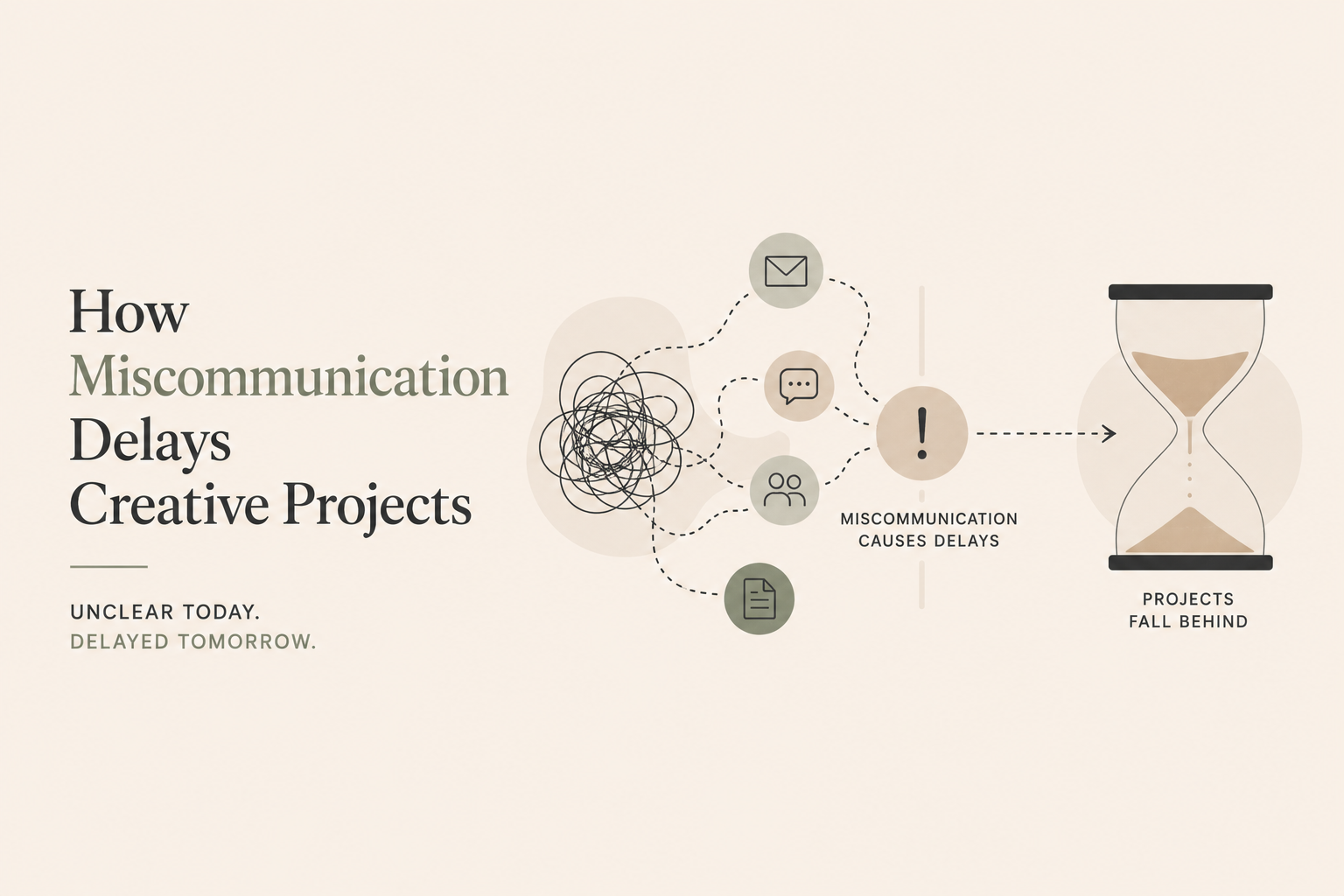
Most creative project delays are not caused by bad design.
They're not caused by lack of talent.
They're not even caused by difficult clients.
More often than agencies would like to admit, projects are delayed because people misunderstand each other.
A missed comment.
An unclear brief.
A forgotten approval.
A misunderstood revision request.
A stakeholder who thought someone else was responsible.
Small communication gaps create large operational problems.
And in creative work, miscommunication is one of the most expensive inefficiencies an agency can experience.
The Invisible Problem Behind Most Delays
When projects fall behind schedule, agencies often blame:
Scope creep
Client responsiveness
Resource shortages
Tight deadlines
While these factors contribute, many delays originate much earlier.
They begin when information fails to move clearly between people.
The challenge is that communication failures are difficult to spot.
Unlike missed deadlines, they don't appear on project plans.
Instead, they quietly create confusion that compounds over time.
What Miscommunication Looks Like in Creative Projects
Miscommunication rarely appears as a major mistake.
It usually begins with small misunderstandings.
The Brief Isn't Fully Understood
The client describes one outcome.
The team interprets another.
The project starts moving in the wrong direction before anyone realizes it.
Weeks later, revisions begin.
Feedback Gets Lost
Comments arrive through:
Emails
Messaging apps
Meetings
Voice notes
Phone calls
Some feedback gets documented.
Some doesn't.
Important information disappears.
Stakeholders Assume Alignment
Many teams believe everyone understands the plan.
In reality:
Designers interpret requirements differently.
Project managers communicate different priorities.
Clients assume requests have been implemented.
Everyone believes they're aligned until delivery reveals otherwise.
Decisions Aren't Recorded
A decision made during a call feels clear in the moment.
A week later:
Nobody remembers exactly what was approved.
Stakeholders disagree about previous decisions.
Discussions start again.
Projects lose momentum.
Why Creative Work Is Especially Vulnerable
Creative projects involve interpretation.
Unlike engineering or accounting, creative work contains subjective elements.
Questions like:
Does this feel premium?
Is the design modern enough?
Does the message resonate?
can have multiple valid answers.
This makes communication clarity even more important.
When objectives are vague, misunderstandings multiply.
The Hidden Cost of Miscommunication
Many agencies underestimate how expensive communication failures can become.
Increased Revision Cycles
Misunderstood requirements inevitably create more revisions.
Work is redone.
Timelines extend.
Profit margins shrink.
Delayed Approvals
Clients hesitate to approve work when expectations and outcomes don't align.
Projects remain stuck in review.
Reduced Productivity
Teams spend time:
Clarifying decisions
Searching for information
Resolving misunderstandings
Repeating discussions
Instead of creating value.
Client Frustration
Nothing damages confidence faster than a client repeatedly explaining the same requirement.
Miscommunication erodes trust.
Team Burnout
Repeatedly revisiting work because of unclear communication is mentally exhausting.
Teams become frustrated when avoidable mistakes continue occurring.
The Four Most Common Sources of Miscommunication
1. Fragmented Feedback
Feedback spread across multiple channels creates confusion.
When comments live in:
Email threads
Slack conversations
WhatsApp messages
Meeting notes
teams struggle to identify the latest instruction.
2. Unclear Ownership
When responsibilities are ambiguous:
Tasks are missed
Decisions are delayed
Accountability disappears
Everyone assumes someone else is handling the issue.
3. Poor Briefing Processes
Many project problems begin with incomplete briefs.
Without clear objectives, creative teams fill gaps with assumptions.
Assumptions often lead to revisions.
4. Lack of Documentation
Organizations frequently rely on memory instead of records.
But memory does not scale.
Documented decisions create clarity.
Undocumented decisions create confusion.
Why Meetings Don't Solve Miscommunication
Many agencies respond to communication problems with more meetings.
Ironically, this often makes the problem worse.
Meetings generate information.
But information only becomes useful when it is:
Captured
Organized
Accessible
Actionable
Without documentation, meetings simply create additional opportunities for miscommunication.
How High-Performing Agencies Prevent Communication Breakdowns
The best agencies don't rely on better conversations.
They rely on better systems.
Centralized Feedback
All comments exist in one location.
Everyone works from the same source of truth.
Structured Briefs
Projects begin with clear objectives, deliverables, audiences, and success criteria.
Less ambiguity means fewer misunderstandings.
Documented Decisions
Approvals, changes, and stakeholder decisions are recorded and accessible.
This prevents repeated discussions.
Defined Review Workflows
Teams know:
Who reviews
Who approves
Who implements feedback
Clear ownership accelerates progress.
Quality Control Processes
Many communication problems are discovered late because review systems are weak.
Proactive quality control helps teams identify issues before clients encounter them.
The Role of Creative Workflow Tools
Modern creative teams increasingly use specialized workflow and review platforms to reduce communication friction.
These tools help teams:
Manage feedback
Track revisions
Document decisions
Monitor approvals
Improve visibility
The result is fewer misunderstandings and faster project delivery.
Communication Is an Operational System
Many agencies think communication is a people problem.
In reality, communication is often a systems problem.
When information depends on memory, meetings, and scattered conversations, mistakes become inevitable.
The strongest agencies build communication systems that reduce reliance on individual habits.
This creates consistency regardless of project size or team structure.
Conclusion
Miscommunication is rarely dramatic.
It is subtle, recurring, and costly.
A misunderstood brief, missing comment, undocumented decision, or unclear approval can delay projects by days or even weeks.
The agencies that consistently deliver on time are not necessarily better communicators.
They simply have better communication systems.
Because successful creative projects depend on more than great ideas.
They depend on ensuring everyone understands those ideas in exactly the same way.
Frequently asked questions
1. Why does miscommunication happen so frequently in creative projects?
Creative projects involve multiple stakeholders, subjective feedback, evolving requirements, and numerous communication channels. Without structured workflows, misunderstandings become common.
2. How does miscommunication affect project timelines?
Miscommunication leads to revision cycles, delayed approvals, duplicated work, missed tasks, and repeated discussions, all of which extend project timelines and reduce efficiency.
3. What are the biggest sources of communication breakdowns in agencies?
Common causes include fragmented feedback, unclear ownership, incomplete project briefs, undocumented decisions, and reliance on informal communication methods.
4. How can agencies improve communication without increasing meetings?
Agencies can centralize feedback, document decisions, create structured review processes, clarify responsibilities, and use workflow tools that keep information organized and visible.
5. How does better communication improve profitability?
Clear communication reduces rework, shortens review cycles, accelerates approvals, improves resource utilization, and allows agencies to deliver projects more efficiently and profitably.