Clients see the final logo.
The approved website.
The finished campaign.
The polished packaging design.
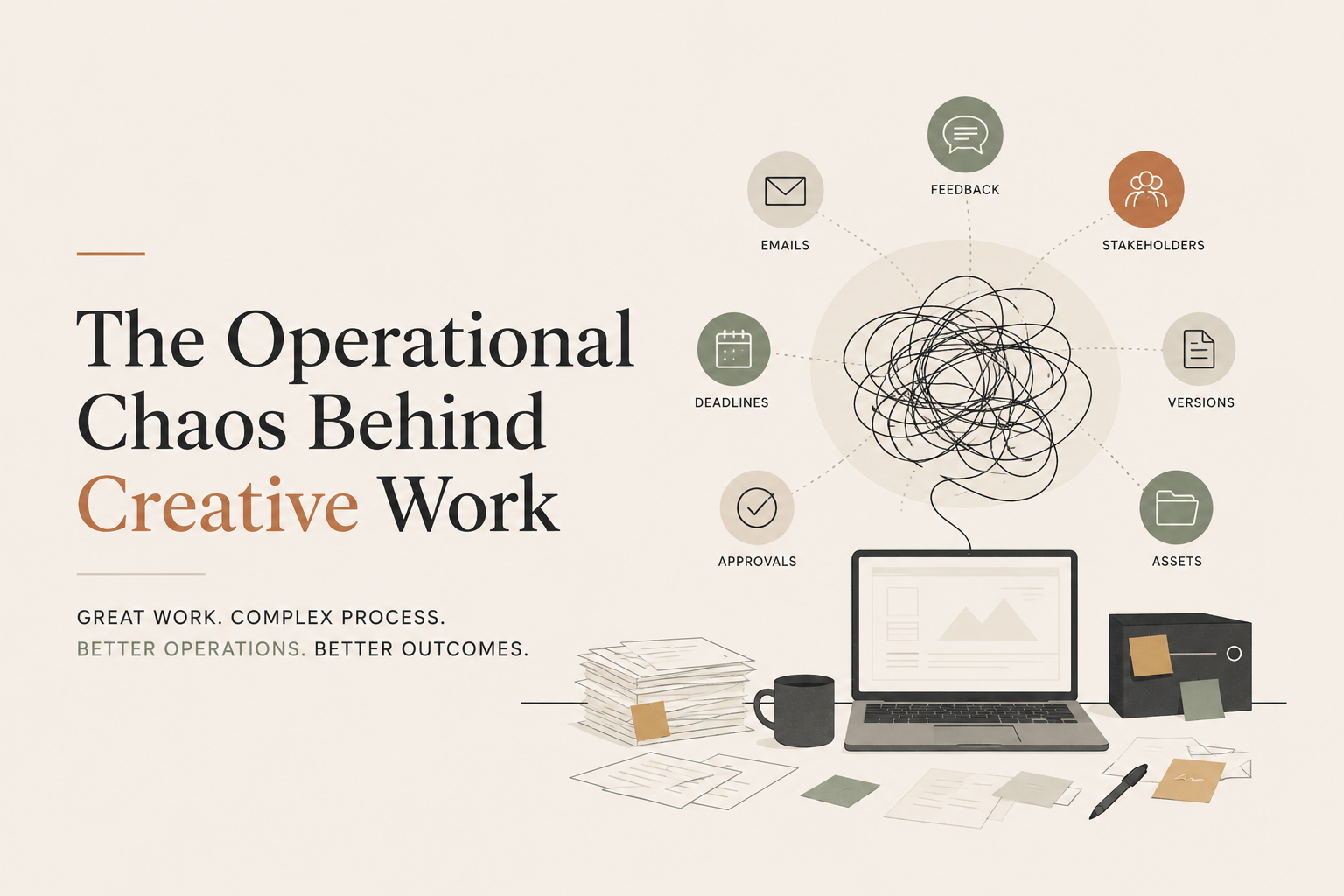
What they rarely see is the operational chaos happening behind the scenes.
Every creative project involves countless moving parts:
Briefs
Feedback
Revisions
Approvals
Asset management
Quality checks
Stakeholder communication
Version control
When these elements aren't managed effectively, even the most talented creative teams struggle to deliver consistently.
The reality is that creative excellence often depends less on talent and more on operations.
The Myth of Pure Creativity
Many people imagine creative work as a process driven solely by inspiration.
In reality, most agency and design team challenges aren't creative problems.
They're operational problems.
Projects fail because:
Requirements are unclear
Feedback arrives late
Decisions aren't documented
Assets go missing
Teams work on outdated files
Quality issues are discovered too late
None of these issues are solved by hiring more talented designers.
They are solved through better systems.
What Operational Chaos Looks Like
Creative chaos rarely appears all at once.
Instead, it accumulates through small inefficiencies.
Endless Revision Loops
Feedback comes from multiple stakeholders.
Comments arrive through:
Email
WhatsApp
Slack
Meetings
Phone calls
The team spends more time organizing feedback than implementing it.
Version Confusion
How many agencies have experienced this?
Final_v3.ai
Final_v4.ai
Final_v4_Updated.ai
Final_v4_Updated_Final.ai
Final_v4_Updated_Final_Latest.ai
Version chaos creates mistakes, delays, and client frustration.
Approval Bottlenecks
Designs are ready.
The team is waiting.
The client is busy.
The decision-maker is unavailable.
Projects stall because approval systems are unclear.
Hidden Rework
One small design mistake triggers:
Additional review rounds
Internal discussions
Client clarification
New exports
Fresh approvals
What appears to be a minor issue often creates hours of invisible work.
Why Creative Teams Become Overwhelmed
As agencies grow, complexity increases faster than expected.
More clients mean:
More communication
More projects
More stakeholders
More assets
More deadlines
Without scalable workflows, operational complexity eventually overwhelms the team.
This leads to:
Missed deadlines
Burnout
Reduced quality
Client dissatisfaction
Growth without operational maturity creates chaos.
The True Cost of Operational Inefficiency
Many agencies focus on revenue while ignoring operational waste.
But inefficiencies directly affect profitability.
Every unnecessary revision, missed approval, or quality issue creates costs.
Common consequences include:
Reduced Profit Margins
Extra work often isn't billable.
The agency absorbs the cost.
Lower Team Productivity
Designers spend time managing processes instead of creating work.
Slower Project Delivery
Projects take longer than estimated.
Deadlines become harder to meet.
Client Frustration
Communication gaps create uncertainty and erode trust.
The Four Sources of Creative Chaos
Most operational problems can be traced back to four core areas.
1. Fragmented Communication
Feedback scattered across multiple channels creates confusion.
Teams waste time searching for information.
2. Lack of Workflow Visibility
Without clear project visibility, nobody knows:
What is pending
What is approved
What requires action
This creates unnecessary follow-ups and meetings.
3. Poor Quality Control
Creative errors discovered late are significantly more expensive to fix.
Examples include:
Typography issues
Alignment inconsistencies
Missing assets
Incorrect dimensions
Brand guideline violations
The later an issue is discovered, the higher the cost.
4. Unstructured Approval Systems
When approval responsibilities are unclear, projects become stuck in review cycles.
Teams wait.
Clients wait.
Progress slows.
How High-Performing Creative Teams Operate
The best agencies don't eliminate complexity.
They manage it.
Their workflows are built around:
Centralized Communication
Feedback exists in one location.
Everyone works from the same source of truth.
Structured Review Processes
Design reviews follow predefined workflows.
This reduces confusion and speeds up decision-making.
Version Control
Every stakeholder knows which file is current.
No guessing.
No duplicate work.
Proactive Quality Assurance
Errors are identified before reaching clients.
This minimizes costly rework and improves delivery consistency.
Clear Ownership
Every project has defined responsibilities.
Teams know:
Who reviews
Who approves
Who executes
Who owns final decisions
This dramatically reduces operational friction.
Why Operations Are Becoming a Competitive Advantage
Historically, agencies competed primarily on creative quality.
Today, clients expect both creativity and efficiency.
The agencies that win consistently are often the ones that:
Deliver faster
Communicate clearly
Reduce revision cycles
Maintain quality at scale
Create predictable project experiences
Strong operations amplify creative talent.
Weak operations limit it.
The Role of Creative Workflow Tools
Modern agencies increasingly rely on specialized tools to reduce operational chaos.
These tools help with:
Design reviews
Quality control
Feedback management
Project visibility
Approval tracking
Team collaboration
The goal is not to replace creativity.
The goal is to remove the operational friction that prevents creativity from thriving.
Conclusion
Behind every successful creative project lies a hidden operational system.
When communication is fragmented, approvals are unclear, and quality control is inconsistent, creative teams become trapped in cycles of rework and inefficiency.
The most successful agencies understand that operational excellence is not separate from creative excellence.
It enables it.
Because great creative work isn't just about generating ideas.
It's about consistently delivering those ideas without chaos.
Frequently asked questions
1. What causes operational chaos in creative agencies?
Operational chaos is typically caused by fragmented communication, unclear approval processes, poor version control, inconsistent quality checks, and a lack of structured workflows. These issues compound as agencies grow.
2. How does operational inefficiency affect agency profitability?
Operational inefficiencies create hidden costs through rework, delays, missed deadlines, excessive revisions, and lower team productivity. These factors reduce profit margins and limit scalability.
3. Why do creative projects often experience revision overload?
Revision overload usually occurs when feedback is collected from multiple stakeholders without a structured review process. Unclear requirements and undocumented decisions further increase revision cycles.
4. How can agencies reduce operational chaos?
Agencies can reduce chaos by centralizing feedback, implementing clear approval workflows, improving quality control, establishing version management systems, and using creative workflow software.
5. What role does quality control play in creative operations?
Quality control helps identify design errors before they reach clients. Effective quality assurance reduces rework, improves client satisfaction, shortens review cycles, and contributes to healthier project margins.