Most creative teams treat all feedback the same.
That's a mistake.
A comment about a typo is not the same as a comment about a concept.
A suggestion about alignment is not the same as a discussion about brand positioning.
Yet many agencies, design teams, and clients mix every type of feedback into a single review process.
The result is confusion.
Conversations become longer.
Revision cycles increase.
Decisions slow down.
And creative work often suffers.
The most effective creative teams understand that there are two fundamentally different types of feedback:
Creative Feedback and Productive Feedback.
Knowing when to use each is the difference between meaningful collaboration and endless revisions.
What Is Creative Feedback?
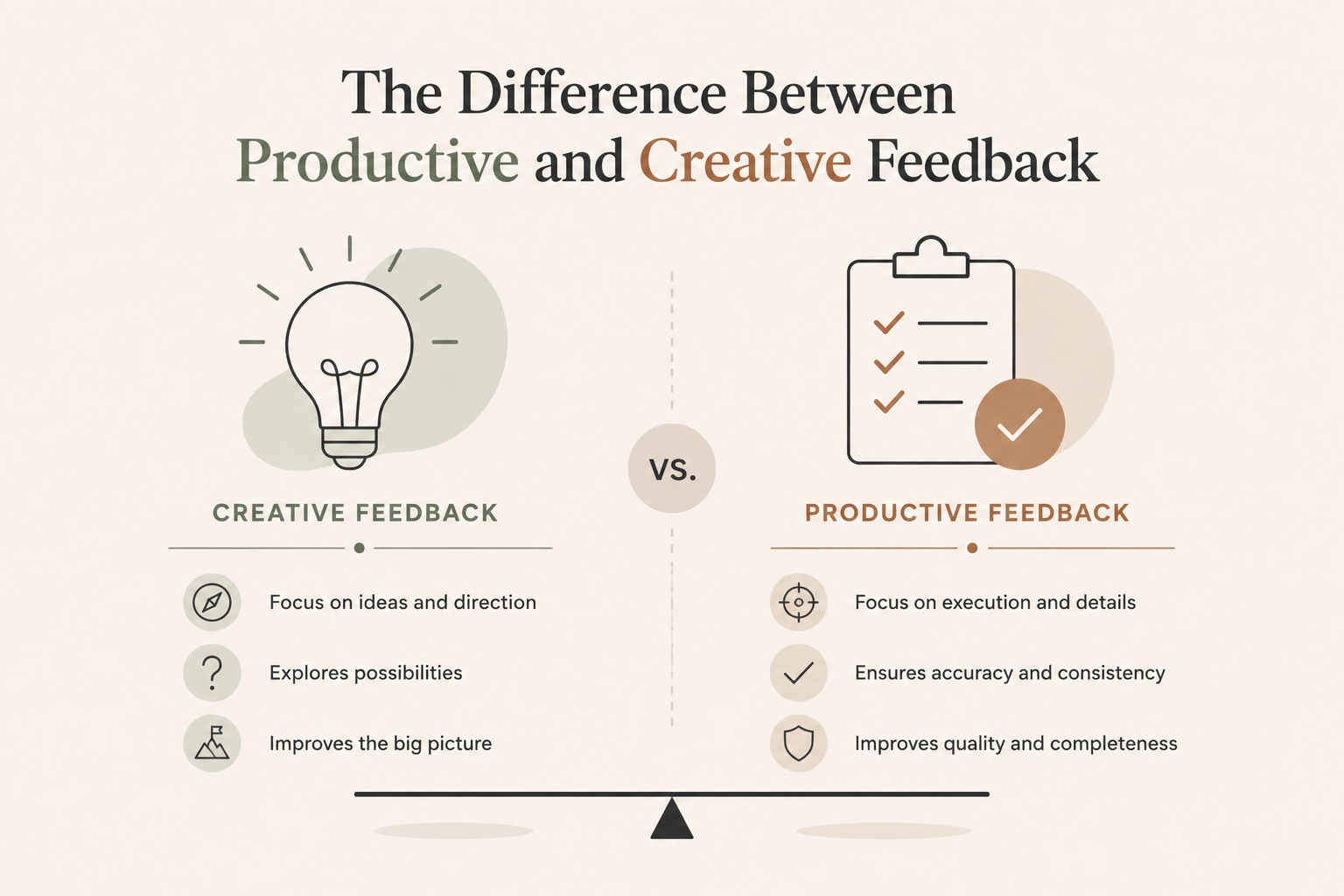
Creative feedback focuses on ideas.
Its purpose is to improve thinking, explore possibilities, and strengthen the overall direction of a project.
Creative feedback typically happens during:
Discovery
Concept development
Strategy discussions
Brainstorming sessions
Early design exploration
Questions often include:
Does this idea solve the problem?
Is the concept memorable?
Does it align with the brand?
Are we exploring the strongest direction?
Is there a better approach?
Creative feedback encourages exploration.
The goal is not immediate execution.
The goal is better thinking.
What Is Productive Feedback?
Productive feedback focuses on execution.
Its purpose is to improve accuracy, clarity, consistency, and completion.
Productive feedback typically happens during:
Design reviews
Quality checks
Final approvals
Production stages
Pre-launch reviews
Questions often include:
Is the spelling correct?
Is the alignment consistent?
Are brand guidelines followed?
Is anything missing?
Is the file production-ready?
Productive feedback reduces errors.
The goal is not generating ideas.
The goal is delivering work efficiently.
Why Teams Confuse the Two
Many review meetings combine both feedback types simultaneously.
A typical review might include:
Strategic positioning discussions
Design exploration
Typography corrections
Copy edits
Technical production issues
Everything gets mixed together.
As a result:
Reviews become longer
Decisions become unclear
Stakeholders focus on the wrong things
Revision cycles multiply
The team never knows whether they're discussing ideas or execution.
Creative Feedback Requires Openness
Creative feedback works best when possibilities remain flexible.
At this stage, comments should encourage exploration.
Examples of effective creative feedback:
✅ "Could we communicate trust more strongly?"
✅ "This direction feels modern, but does it reflect the audience?"
✅ "What would happen if we simplified the message?"
Examples of ineffective creative feedback:
❌ "Move the logo 5 pixels left."
❌ "Increase the font size."
❌ "Use a different shade of blue."
These comments focus on execution rather than strategy.
They belong in a different stage of the process.
Productive Feedback Requires Precision
Productive feedback works best when objectives are already established.
At this stage, ambiguity creates problems.
Examples of effective productive feedback:
✅ "The headline is misspelled."
✅ "The spacing between sections is inconsistent."
✅ "Version 3 is missing the legal disclaimer."
✅ "The image dimensions don't match specifications."
Examples of ineffective productive feedback:
❌ "Maybe we should rethink the concept."
❌ "What if we explored a completely different direction?"
❌ "Let's revisit the original strategy."
At this stage, strategic discussions create delays and revision loops.
The Cost of Mixing Feedback Types
When teams fail to separate creative and productive feedback, projects slow dramatically.
Endless Revision Cycles
Concept discussions continue during production.
Production issues appear during strategy reviews.
Projects never fully progress.
Approval Delays
Stakeholders continue debating ideas when they should be approving execution.
Deadlines slip.
Team Frustration
Designers receive conflicting feedback because reviewers are evaluating different things.
One person reviews strategy.
Another reviews details.
Neither is wrong.
But both are operating in different modes.
Reduced Profitability
Every unnecessary revision consumes time, resources, and margin.
The cost compounds across multiple projects.
How High-Performing Agencies Separate Feedback
Successful creative teams intentionally structure reviews.
Stage 1: Creative Review
Focus only on:
Concepts
Direction
Messaging
Brand alignment
Problem-solving
No discussions about production details.
Stage 2: Execution Review
Focus only on:
Layout
Typography
Assets
Content accuracy
Technical requirements
No discussions about changing the overall concept.
Stage 3: Quality Control Review
Focus only on:
Errors
Consistency
Compliance
Production readiness
The work should already be approved creatively.
The Role of Quality Control
One reason productive feedback becomes overwhelming is because teams rely on people to catch every mistake manually.
Common issues include:
Alignment errors
Spacing inconsistencies
Missing elements
Typography mistakes
Version mismatches
When quality control systems improve, teams spend less time discussing execution details and more time focusing on creative outcomes.
This creates a healthier review process.
Why Clients Struggle With Feedback
Clients are rarely trained to distinguish between feedback types.
As a result, they often provide:
Strategic comments during final reviews
Production comments during brainstorming sessions
New ideas after approval
The solution is not educating every client.
The solution is designing review processes that naturally guide feedback toward the right stage.
The Best Creative Teams Use Both
Some organizations prioritize creativity and ignore execution.
Others focus entirely on efficiency and suppress creativity.
Both approaches fail.
Creative feedback helps teams discover the best solution.
Productive feedback helps teams deliver that solution effectively.
High-performing agencies need both.
The challenge is knowing when each belongs in the process.
Conclusion
Creative feedback and productive feedback serve different purposes.
One improves ideas.
The other improves execution.
When teams separate the two, projects move faster, revisions decrease, approvals become easier, and creative work improves.
The most successful agencies don't just ask for feedback.
They create systems that ensure the right feedback happens at the right time.
Because better feedback isn't about getting more opinions.
It's about getting the right opinions at the right stage.
Frequently asked questions
1. What is the difference between creative feedback and productive feedback?
Creative feedback focuses on improving ideas, concepts, messaging, and strategy. Productive feedback focuses on execution, accuracy, consistency, and quality assurance during delivery.
2. Why do creative projects get delayed because of feedback?
Projects are often delayed when creative and productive feedback are mixed together. Strategic discussions continue during production stages, causing additional revisions and slowing approvals.
3. When should creative feedback be given?
Creative feedback is most effective during discovery, concept development, brainstorming, and early design stages when ideas are still flexible and open to exploration.
4. When should productive feedback be given?
Productive feedback should be provided during design reviews, quality checks, approval stages, and production reviews when the focus is on execution and error prevention.
5. How can agencies improve their feedback process?
Agencies can improve feedback by separating strategic reviews from execution reviews, centralizing comments, defining review stages, implementing quality control systems, and clarifying review objectives before each session.