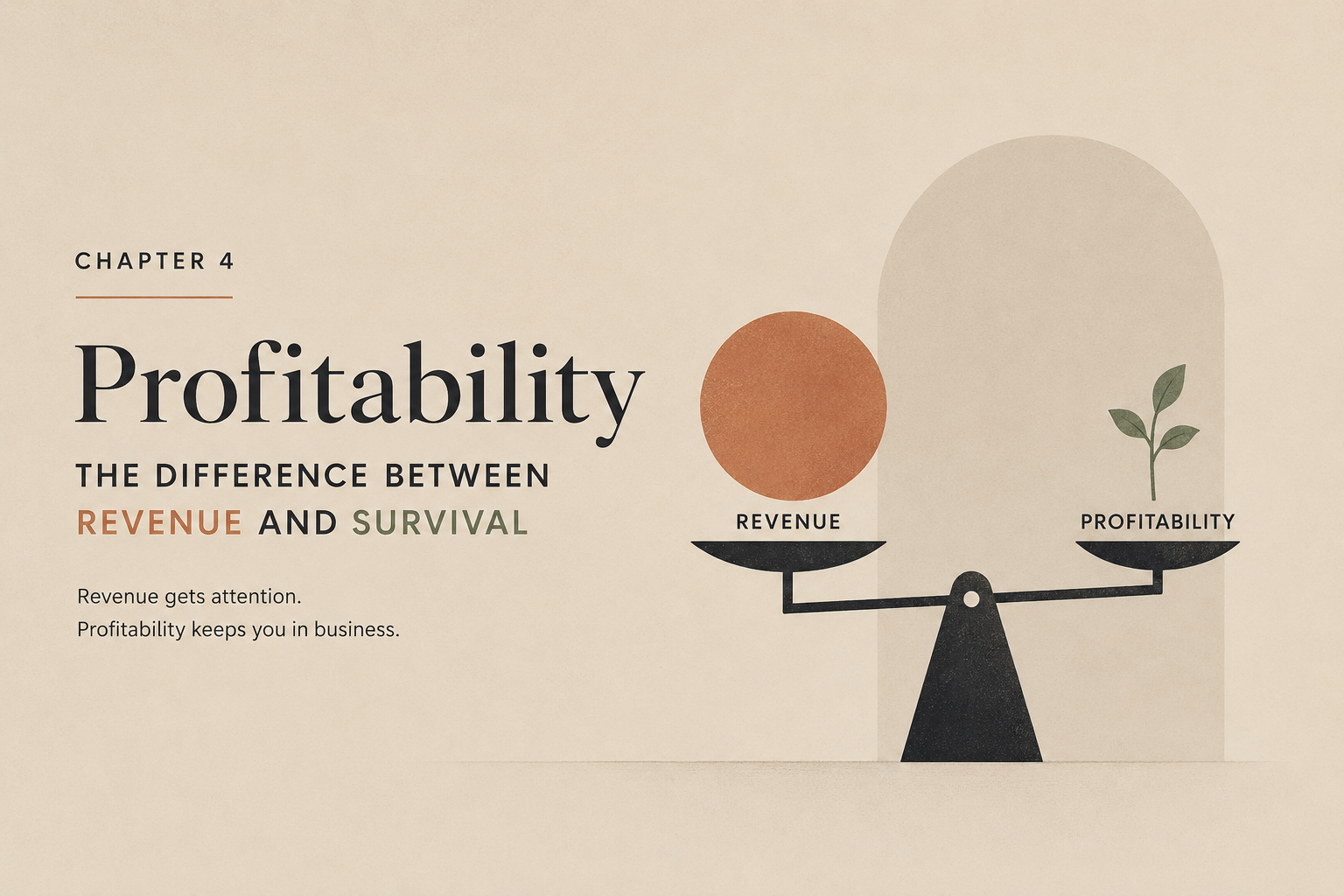
Most agency owners celebrate revenue.
Few monitor profitability with the same intensity.
That's why many creative agencies, design studios, marketing firms, and production houses appear successful on the surface while constantly battling cash flow shortages, delayed salaries, burnout, and financial uncertainty behind the scenes.
Revenue creates visibility.
Profitability creates survival.
Understanding the difference is one of the most important business lessons for agency founders.
Revenue Is Vanity, Profitability Is Reality
Revenue is simply the total money your agency earns from clients.
Profitability is the amount of money left after paying salaries, freelancers, software subscriptions, marketing costs, office expenses, taxes, and operational overhead.
For example:
Agency Revenue: ₹1 Crore
Operational Expenses: ₹90 Lakhs
Net Profit: ₹10 Lakhs
Another agency may generate:
Revenue: ₹60 Lakhs
Operational Expenses: ₹35 Lakhs
Net Profit: ₹25 Lakhs
The second agency is significantly healthier despite generating lower revenue.
This is why agency profitability matters more than agency revenue growth.
Why Creative Agencies Confuse Revenue With Success
Many agency founders unintentionally optimize for:
Bigger projects
More clients
Larger teams
Higher monthly billing
Instead of optimizing for:
Profit margins
Cash flow
Team utilization
Client quality
Operational efficiency
As a result, growth creates complexity faster than profit.
The agency gets bigger but not stronger.
The Hidden Costs That Destroy Agency Profitability
Many creative businesses underestimate costs that silently reduce profit.
1. Excessive Revisions
Projects that were estimated for three rounds of feedback often end with ten.
Without proper project management systems, revisions consume designer hours and reduce margins.
2. Underpriced Services
Many agencies still charge based on effort rather than business value.
This creates a situation where revenue grows but profit remains stagnant.
3. Quality Control Rework
Design errors, missed requirements, incorrect exports, alignment issues, and client-requested corrections generate expensive rework.
Every correction cycle increases production costs without increasing revenue.
4. Context Switching
Designers jumping between multiple projects lose efficiency.
A team that appears busy may actually be operating at low productivity levels.
5. Poor Client Selection
Some clients consume disproportionate amounts of communication, meetings, and revisions while generating limited revenue.
Not all revenue is good revenue.
The Agency Profitability Formula
A sustainable agency business focuses on improving four key metrics:
Revenue per Employee
Measures how efficiently your team generates income.
Higher revenue per employee often indicates better systems and resource allocation.
Gross Profit Margin
Shows how much money remains after delivering the service.
Healthy agencies consistently monitor this metric.
Client Lifetime Value (CLV)
Long-term clients are usually more profitable than constantly acquiring new ones.
Retention often costs less than acquisition.
Utilization Rate
Tracks how much of your team's time is spent on billable work versus internal activities.
Low utilization directly impacts profitability.
Revenue Growth Without Systems Is Dangerous
Many agency owners believe profitability problems will disappear once they acquire more clients.
The opposite often happens.
Without scalable systems:
Communication becomes chaotic
Project tracking becomes inconsistent
Quality issues increase
Revision cycles multiply
Team burnout rises
Every additional project magnifies inefficiencies.
This is why workflow optimization becomes essential before scaling.
How Quality Control Impacts Profitability
One overlooked factor in agency profitability is design quality control.
Small production mistakes can trigger:
Client dissatisfaction
Additional review rounds
Missed deadlines
Team frustration
Lower margins
A single unnoticed typo or alignment issue can consume hours of correction and communication.
This is where structured review workflows become valuable.
Modern design review tools help agencies identify issues earlier, reducing rework costs and improving project profitability.
For growing agencies, quality assurance is no longer just a design concern—it is a financial strategy.
Profitability Benchmarks for Creative Agencies
While benchmarks vary by service model, profitable agencies typically focus on:
Metric | Healthy Target |
|---|---|
Gross Margin | 50%–70% |
Net Profit Margin | 15%–30% |
Client Retention | 70%+ |
Utilization Rate | 70%–85% |
Revision Overruns | Less than 10% of projects |
Tracking these metrics consistently provides a clearer picture of agency health than revenue alone.
The Most Profitable Agencies Think Differently
The best-performing agencies don't ask:
"How can we get more projects?"
They ask:
How can we increase profit per project?
How can we reduce avoidable rework?
How can we improve delivery efficiency?
How can we retain profitable clients longer?
How can we create scalable systems?
These questions transform growth from stressful expansion into sustainable business development.
Conclusion
Revenue attracts attention.
Profitability creates freedom.
An agency generating millions in revenue can still struggle to survive if operational costs, inefficiencies, and rework consume its margins.
The agencies that endure are not necessarily the largest. They are the ones that understand the relationship between revenue, efficiency, quality control, and profitability.
Growth without profit creates pressure.
Profitability creates sustainability.
And sustainability is what ultimately determines whether an agency survives long enough to become truly successful.
Frequently asked questions
1. What is the difference between revenue and profitability?
Revenue is the total income generated from clients before expenses are deducted. Profitability refers to the money remaining after all operational costs, salaries, software subscriptions, taxes, and overheads have been paid. A business can have high revenue but low profitability if expenses are too high.
2. Why do many creative agencies struggle despite growing revenue?
Many agencies focus on acquiring more clients and increasing billings without improving operational efficiency. Excessive revisions, underpriced services, poor project management, and design rework often consume profits, making growth unsustainable.
3. How can agencies improve profitability without increasing prices?
Agencies can improve profitability by reducing rework, streamlining client feedback, improving team utilization, standardizing workflows, retaining high-value clients, and implementing effective quality control processes. Often, operational improvements have a greater impact than simply raising rates.
4. How does design quality control affect agency profitability?
Design quality control helps identify mistakes before they reach clients. Fewer errors mean fewer revisions, reduced project delays, improved client satisfaction, and lower production costs. Over time, efficient quality control directly contributes to higher profit margins and healthier agency operations.