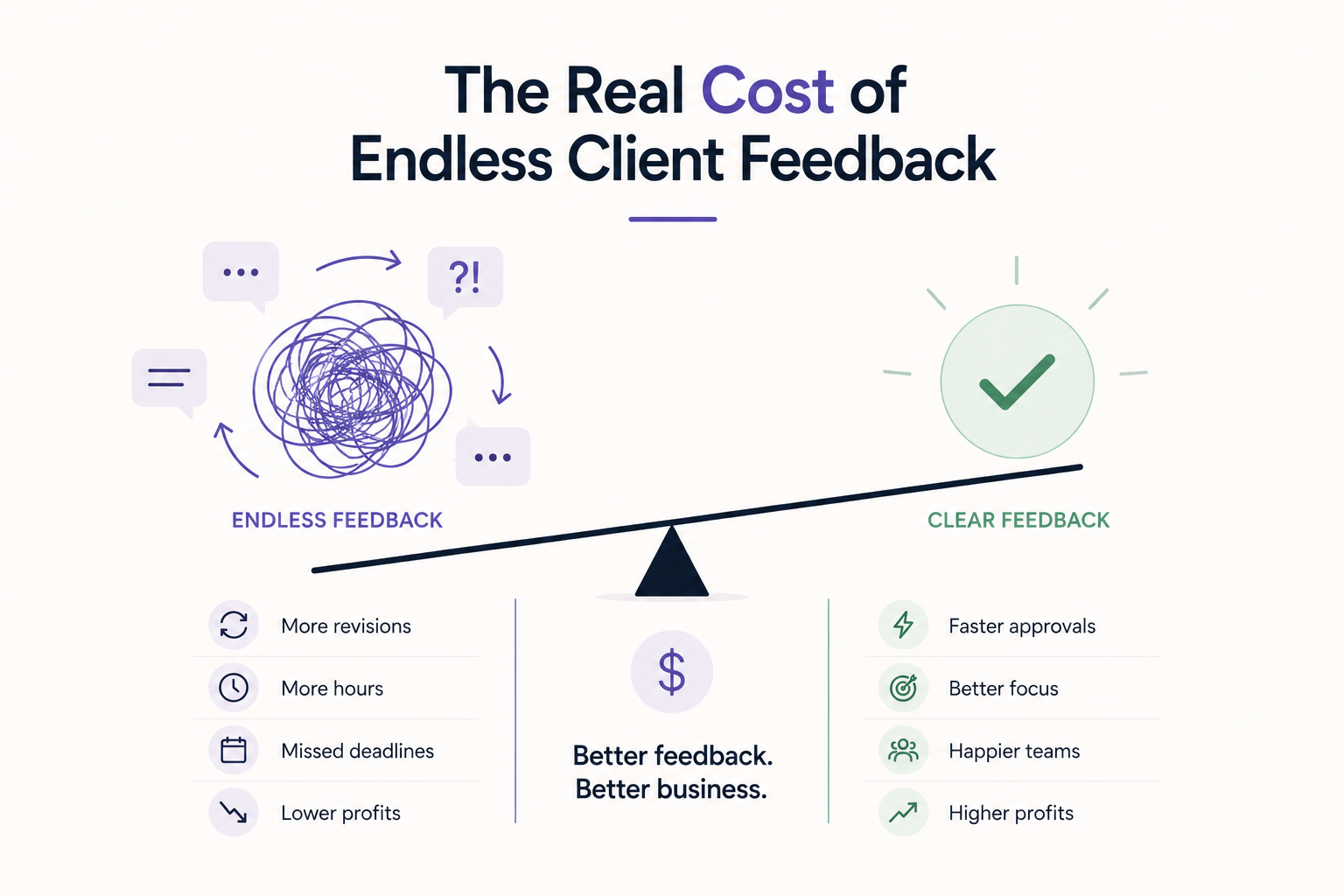
Feedback Is Essential. Endless Feedback Is Expensive.
Every agency wants client feedback.
Without feedback, projects drift away from client expectations.
Without feedback, stakeholders feel excluded.
Without feedback, good ideas often fail.
But somewhere along the way, many agencies confuse helpful feedback with unlimited feedback.
And that's where problems begin.
What starts as collaboration often evolves into:
Endless comments
Never-ending revisions
Conflicting opinions
Delayed approvals
Frustrated teams
Most agencies can clearly see the time being spent.
What they often fail to see is the hidden cost accumulating beneath the surface.
Because endless client feedback doesn't just slow projects down.
It slowly erodes profitability, team morale, creative quality, and client relationships.
Why Feedback Keeps Growing
Many agencies assume excessive feedback happens because clients are difficult.
That's rarely the whole story.
Endless feedback is usually the result of process failures.
Common causes include:
Unclear objectives
Poor stakeholder alignment
Lack of approval structures
Weak review systems
Undefined decision-makers
When clarity decreases, feedback increases.
People compensate for uncertainty by requesting more changes.
The Feedback Snowball Effect
A single comment rarely stays isolated.
Consider a simple request:
"Can we make the headline larger?"
That change might affect:
Layout balance
Visual hierarchy
Copy length
Mobile responsiveness
Supporting graphics
One revision creates three more considerations.
Three revisions create ten.
Ten revisions create an entirely new review cycle.
Feedback compounds faster than most agencies realize.
The Hidden Costs Agencies Don't Measure
Most agencies track:
Billable hours
Project timelines
Revenue
Few track the true cost of feedback.
Let's break it down.
Cost #1: Lost Designer Hours
The most obvious cost is time.
Every revision requires:
Understanding feedback
Interpreting comments
Updating files
Internal reviews
Exporting assets
Communicating updates
A "small" feedback request rarely takes five minutes.
The operational cost is usually much higher.
Across dozens of projects, these small requests become massive productivity leaks.
Cost #2: Context Switching
Designers perform best when focused.
Endless feedback forces them to constantly switch between:
Different clients
Different projects
Different revisions
Research consistently shows that context switching reduces productivity and increases mistakes.
The actual cost isn't the revision itself.
It's the interruption.
Cost #3: Creative Fatigue
Creative energy is not unlimited.
The tenth revision round often receives less enthusiasm than the first.
Not because designers care less.
Because repetitive revisions drain cognitive resources.
Over time, teams stop improving the work.
They simply respond to comments.
Creativity becomes reactive.
Cost #4: Decision Fatigue
Clients experience fatigue too.
The more options they review, the harder decisions become.
Eventually stakeholders start saying:
"Let's see one more version."
"Can we explore another route?"
"Maybe we should revisit the previous option."
Not because the work is wrong.
Because decision-making becomes harder as choices increase.
Why More Feedback Doesn't Always Improve Quality
Many clients assume:
More feedback = Better work.
In reality:
More feedback often creates more complexity.
As stakeholder count increases:
Opinions multiply
Objectives conflict
Priorities shift
Decisions slow down
The project gradually moves away from a clear vision.
Instead of creating a stronger solution, agencies often create a compromise.
And compromises rarely produce exceptional creative work.
The Stakeholder Problem
One stakeholder can create feedback.
Five stakeholders can create chaos.
Every additional reviewer introduces:
New preferences
New concerns
New assumptions
New priorities
For example:
Marketing wants visibility.
Sales wants more information.
Leadership wants branding.
Product wants usability.
Legal wants compliance.
Each request may be valid individually.
Together, they often create contradiction.
The Cost of Delayed Approvals
Feedback doesn't just affect designers.
It affects project timelines.
When approvals stretch from days into weeks:
Launches get delayed
Campaigns miss opportunities
Resources remain allocated
Revenue recognition slows
The financial impact often exceeds the revision cost itself.
A delayed launch can be significantly more expensive than the design changes causing the delay.
Why Agencies Struggle to Push Back
Many agencies recognize excessive feedback.
Few address it.
Why?
Because client relationships feel fragile.
Agency leaders worry:
What if the client gets upset?
What if we lose the account?
What if they leave a negative review?
As a result, agencies absorb revision costs quietly.
The client remains happy.
The agency becomes less profitable.
The Revision-Profitability Connection
Let's consider a simple example.
Project Value
₹2,00,000
Planned Delivery Time
40 hours
Actual Delivery Time
65 hours
What caused the difference?
Additional review rounds
Multiple stakeholder approvals
Repeated revisions
Feedback clarification
The project revenue didn't change.
The cost did.
Profit disappeared.
This happens every day across creative agencies.
Why Email Makes Feedback Worse
Many agencies still manage feedback through:
Email chains
PDFs
Messaging apps
Meeting notes
This creates several challenges.
Duplicate Comments
The same issue appears multiple times.
Lost Context
Nobody remembers why a decision was made.
Approval Confusion
Teams don't know what has actually been approved.
Version Chaos
Stakeholders review outdated files.
The result is more feedback, not better feedback.
The Rise of Structured Review Processes
High-performing agencies increasingly treat feedback as an operational process rather than an informal conversation.
Instead of collecting comments everywhere, they centralize communication.
Modern creative review platforms such as Revue help agencies organize:
Feedback
Annotations
Approvals
Version history
Stakeholder discussions
The goal isn't fewer comments.
The goal is better comments.
When feedback becomes structured, teams spend less time interpreting and more time improving.
How Agencies Can Reduce Feedback Waste
1. Define Objectives Upfront
Every project should begin with clarity around:
Goals
Audience
Success metrics
Constraints
Feedback becomes more productive when everyone understands the target.
2. Limit Reviewers
Not everyone needs approval authority.
Define:
Decision-makers
Contributors
Observers
This prevents unnecessary feedback loops.
3. Ask Specific Questions
Replace:
"What do you think?"
With:
Does this meet the objective?
Is anything factually incorrect?
Is anything missing?
Specific questions generate useful feedback.
4. Create Approval Stages
Separate reviews into phases:
Strategic Review
Validate direction.
Creative Review
Validate concepts.
Quality Review
Validate accuracy.
Each stage should answer different questions.
5. Centralize Communication
A single source of truth eliminates confusion and reduces duplicate conversations.
The easier feedback is to track, the faster projects move.
What Elite Agencies Understand
The best agencies don't fear feedback.
They fear unstructured feedback.
Because they know:
Every unnecessary comment creates:
Additional work
Additional delays
Additional costs
The goal isn't to eliminate collaboration.
The goal is to create efficient collaboration.
The difference is enormous.
Conclusion
Client feedback is one of the most valuable parts of the creative process.
But when feedback becomes endless, its costs begin to outweigh its benefits.
The agencies that scale successfully understand that feedback must be managed just like budgets, timelines, and resources.
Because feedback is not free.
Every comment carries a cost.
The question isn't whether feedback should exist.
The question is whether the value created by the feedback exceeds the cost of implementing it.
The agencies that answer that question well are the ones that remain profitable as they grow.
Frequently asked questions
Why does endless client feedback hurt agency profitability?
Every additional feedback round consumes design, project management, and communication time without necessarily increasing project revenue.
How can agencies reduce excessive revisions?
By aligning stakeholders early, defining approval stages, centralizing feedback, and asking more structured review questions.
Why do stakeholders keep requesting changes?
Common reasons include uncertainty, lack of alignment, fear of decision-making, and unclear project objectives.
What is the biggest hidden cost of client feedback?
Context switching and lost productivity are often more expensive than the actual revision work itself.
How can agencies manage feedback more efficiently?
Using structured review workflows, centralized approval systems, and clear stakeholder roles can dramatically reduce feedback waste.