Most agencies think they lose money because clients negotiate hard, budgets are tight, or competition is aggressive.
That’s not the full picture.
A huge chunk of agency profit disappears much later — after the pitch is won, after the project kicks off, and after the first round of work is already in motion.
It disappears in revisions.
Not the occasional, healthy revision that improves the work.
The real margin killer is uncontrolled revision work: scattered feedback, unclear scope, repeated changes, endless internal corrections, wrong versions, and approvals that never properly close.
On paper, the project still looks profitable. The invoice amount hasn’t changed. The client may even be happy. But inside the team, hours keep leaking. Designers keep reopening files. Account managers keep chasing clarification. Founders and creative directors keep stepping in to resolve confusion. Delivery stretches. Team capacity shrinks. Profit gets quietly consumed by work nobody planned, tracked, or priced correctly.
That’s the real problem with revisions in agencies: they rarely look expensive while they’re happening.
They only show up later as low margins, overworked teams, delayed timelines, and a pipeline that feels busier than it should for the revenue it brings in.
If your agency is constantly “working a lot” but still struggling to protect profitability, revisions are one of the first places you should look.
Revisions Are Not the Problem. Uncontrolled Revisions Are.
No serious agency should expect zero revisions. Creative work is collaborative by nature. Clients need to react to concepts, refine messaging, test options, align stakeholders, and adapt ideas to changing priorities. Some amount of revision is normal and healthy.
The issue starts when revisions stop being part of a defined process and start becoming an unstructured loop.
That usually looks like this:
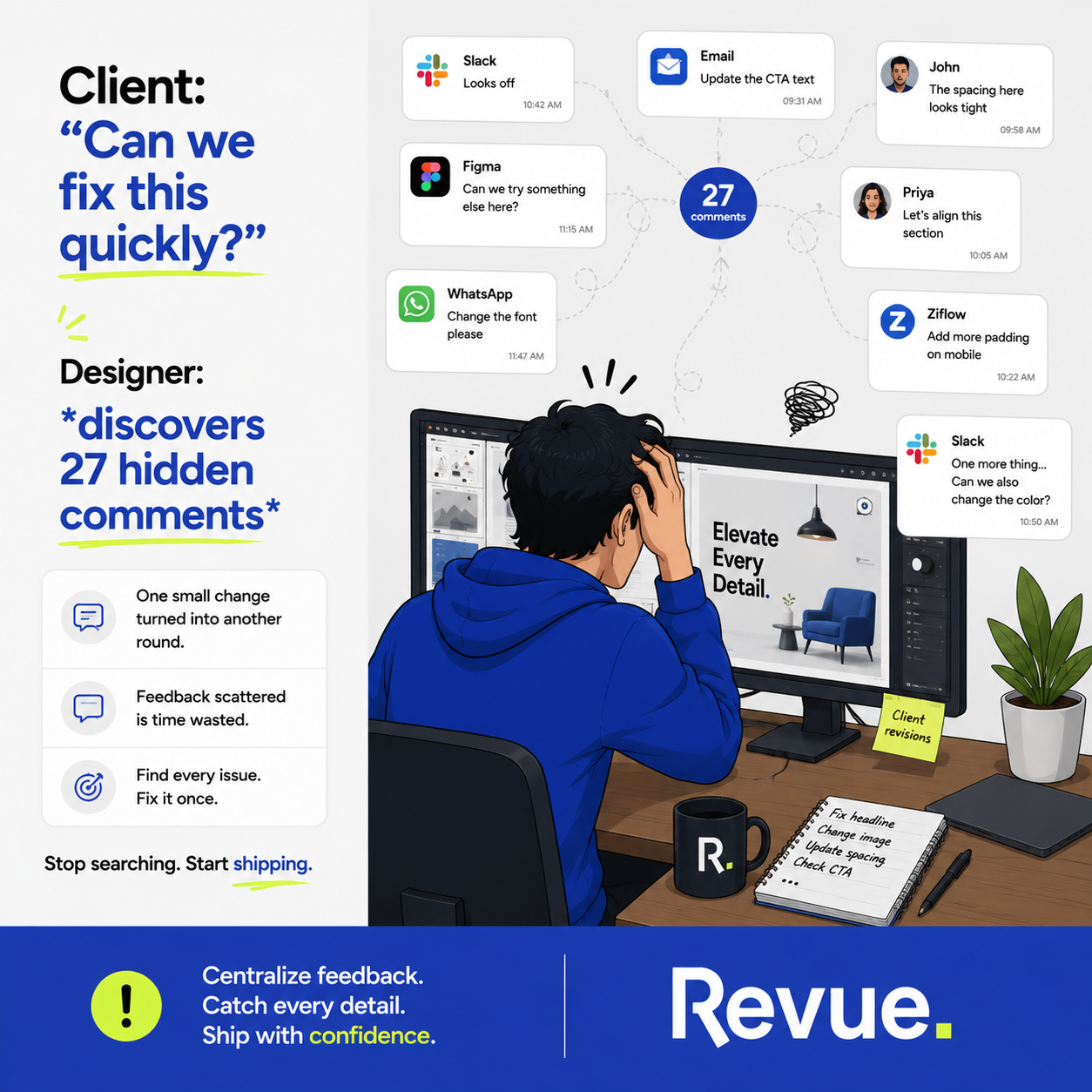
feedback arrives across email, Slack, WhatsApp, calls, and screenshots
multiple stakeholders comment at different times with conflicting requests
the team revises work before feedback is consolidated
“small changes” reopen already approved work
internal teams keep polishing because nobody knows whether the file is truly final
clients review old versions because the latest one wasn’t clearly shared
there’s no clean line between included revisions and additional scope
At that point, the agency isn’t doing revision work. It’s doing revision recovery work — spending time not just making changes, but also interpreting, chasing, reconciling, comparing, validating, and resending.
That’s where profit dies.
Why Revisions Hurt Agency Profit More Than People Realize
Revisions are dangerous because the cost doesn’t show up in one obvious place. It spreads across the system.
A single revision request might sound harmless:
“Can we try one more version?”
“Can you make the headline stronger?”
“Let’s test a cleaner layout.”
“Can we see another option before finalizing?”
None of those sound catastrophic. But multiply them across multiple projects, multiple stakeholders, and multiple creative rounds, and the financial impact compounds fast.
Here’s how agencies actually lose money on revisions.
1. Revisions Consume Unpriced Production Hours
The most obvious cost is also the one agencies under-measure the most: time.
Every revision creates labor. A designer reopens the file, revisits the layout, makes changes, exports assets, uploads versions, and sends it back for review. A copywriter may need to adjust messaging. An account manager may need to translate feedback, coordinate approvals, or explain the rationale behind changes. A creative lead may need to review the revised output again before it goes out.
The problem is that agencies often price the original deliverable, but they don’t rigorously price the real amount of revision labor that follows.
So the project fee stays fixed while the internal cost keeps rising.
That gap destroys margins quietly. Not in one dramatic moment, but in dozens of 20-minute, 40-minute, and 90-minute chunks spread across the lifecycle of the project.
2. Revisions Break Team Capacity Planning
Agencies don’t just lose money on the hours spent revising. They lose money on the work those hours replace.
When a designer is stuck in repeated revision loops for one project, they’re not moving another project forward. When an account manager spends half the day chasing fragmented feedback, they’re not managing delivery proactively elsewhere. When a creative director has to resolve avoidable review chaos, they’re not working on higher-value strategy, pitching, or quality improvement.
This is the hidden opportunity cost of bad revision management.
A team that should be able to handle 10 profitable projects may only effectively handle 6 or 7 because revisions are consuming capacity that was never planned for. That means slower delivery, lower throughput, and less revenue generated per employee.
In other words, revisions don’t just reduce profit on one project. They reduce the earning power of the agency as a whole.
3. Scattered Feedback Creates Expensive Interpretation Work
One of the biggest myths in agency operations is that revision time is only the time spent “making the changes.”
Wrong.
A huge percentage of revision cost comes before anyone touches the design file.
Someone has to gather comments from email threads, Slack messages, call notes, PDFs, screenshots, and client messages. Someone has to figure out which feedback is current, which stakeholder has approval authority, which comments conflict, and what exactly “make it more premium” or “make it pop” is supposed to mean in practical terms.
That translation work is expensive because it burns senior attention.
Designers end up decoding vague comments. Account managers become human routers for client input. Creative leads spend time arbitrating subjective feedback that should have been consolidated earlier.
This is where agencies start searching for things like:
creative feedback management software
design review tools for agencies
proofing software for creative teams
client feedback tools for design projects
agency workflow management software
Not because they need “another tool,” but because scattered feedback has already become a profit leak.
4. Internal Revisions Are Often Worse Than Client Revisions
Most agencies blame the client for revision pain. That’s lazy thinking.
A lot of revision waste is internal.
Sometimes the team doesn’t align on the brief properly. Sometimes account management overpromises and under-specifies. Sometimes the creative direction changes halfway through. Sometimes leadership gives late-stage subjective feedback because they weren’t brought in at the right moment. Sometimes no one defined what “approved” actually means.
That creates internal revision loops before the client even enters the picture.
The designer reworks a concept because the strategy wasn’t clear.
The copy changes because messaging wasn’t locked.
The deck gets revised because leadership sees it too late.
The social creatives are adapted twice because the master direction wasn’t signed off.
The client never sees that waste, but the agency pays for every minute of it.
If you want to understand why your margins are weak, stop looking only at client behavior. Audit your own review process first.
5. Poor Version Control Creates Duplicate Work
Revision chaos gets much worse when version control is weak.
The wrong file gets reviewed. A stakeholder comments on an outdated export. Someone implements feedback on version 5 while the client is already looking at version 7. Another team member makes changes on a local file that no one else sees. Then the agency spends time reconciling what changed, what was approved, and what needs to be redone.
That is not a small operational inconvenience. That is duplicated labor.
Every time the team revisits a file because the wrong version moved through the workflow, profit takes another hit.
This is why agencies that rely only on chat threads, shared folders, and naming conventions eventually run into the same wall. Storage is not version control. Communication is not workflow clarity. “Use the latest file” is not a process.
6. Revision Cycles Expand Because Approval Gates Are Weak
A lot of agencies think they have an approval process because work gets shown to the client and someone eventually says yes.
That’s not an approval process. That’s hope.
A real approval process defines:
who reviews first
what kind of feedback is expected at each stage
who has final sign-off authority
when the work is considered locked
what happens if changes are requested after approval
Without those gates, revisions stay open indefinitely.
A client approves the concept but later changes the copy.
A stakeholder misses the first round and jumps in late.
An internal team member reopens something because “one more improvement” came to mind.
A founder sends feedback after production has already started.
Weak gates create endless surface area for rework. And rework is where margin disappears.
7. Agencies Underestimate the Emotional Cost of Revisions
This part matters more than most founders admit.
Repeated revisions don’t just cost time. They degrade morale.
Designers start feeling like they’re doing endless cleanup instead of meaningful work. Account managers get stuck in client-management fatigue. Creative leads feel like every project needs supervision. Founders get pulled into conflict resolution instead of growth.
Over time, the team becomes slower, more defensive, and less energized. The best people spend more time navigating chaos than producing value.
That has a financial effect too:
slower turnaround
lower creative energy
reduced output quality
higher burnout risk
weaker retention
So yes, revisions hurt project profitability. But they also hurt the long-term operating health of the agency.
The Real Root Cause: Agencies Treat Revisions as a Creative Issue Instead of an Operational Issue
This is the core mistake.
Most agencies respond to revision pain by trying to improve communication informally:
“Let’s be more careful.”
“Let’s explain the brief better.”
“Let’s ask the client to consolidate feedback.”
“Let’s remind the team to use the latest file.”
None of that is enough.
Because the problem is not that people forgot to be careful. The problem is that the agency lacks a system that makes revision control repeatable.
Revisions become profitable only when they’re operationalized.
That means the agency needs structure around:
how feedback is collected
where comments live
who consolidates input
what counts as a revision round
when approvals are locked
how versions are tracked
how QC happens before resubmission
when additional changes become extra scope
Without those rules, every project becomes a negotiation between memory, urgency, and whoever shouts last.
What a Profitable Revision Process Looks Like
A profitable agency doesn’t eliminate revisions. It designs them.
Here’s what that actually looks like.
1. Centralize Feedback in One Place
No feedback across five channels. Comments should live in one review environment attached to the creative itself. That cuts interpretation time and reduces missed changes.
2. Define Revision Rounds Upfront
If a project includes two rounds of revisions, define what that means. Is it one consolidated client response per round? Are internal revisions separate? What counts as a new round? Ambiguity here is where scope expands quietly.
3. Create Clear Approval Stages
Separate concept approval, content approval, design refinement, and final sign-off. If those stages blur together, the same work gets reopened repeatedly.
4. Consolidate Stakeholder Input Before the Team Revises
The creative team should not revise against fragmented feedback from multiple people at different times. Someone — client-side or agency-side — needs to consolidate the comments first.
5. Track Version History Properly
Everyone should know what changed, what’s current, what’s approved, and what’s pending. If your workflow depends on “vFinalFinal2” naming, it’s broken.
6. Build QC Into the Revision Workflow
A revised file should not go back out with a new typo, broken alignment, inconsistent spacing, or missing update. Revisions should pass a quality checkpoint before resubmission, especially when teams are moving fast.
7. Separate Included Revisions from Additional Scope
If a client asks for strategic rework after approvals, new deliverables, or repeated redesign beyond the agreed rounds, that needs to be scoped and billed appropriately. Agencies lose money when they know this but don’t enforce it.
Why This Matters for Revue
Revue sits directly in the layer where agencies lose the most invisible margin: the review-and-revision cycle.
The problem isn’t just “too many comments.” It’s the fact that revisions happen inside a messy system:
feedback scattered across tools
no single source of truth
unclear version ownership
preventable quality issues slipping through
approvals that aren’t really approvals
creative teams spending more time managing revision chaos than doing creative work
A better creative review workflow changes that.
Revue is relevant here because it helps agencies create more structure around the revision loop:
centralized annotations and feedback
clearer review trails
fewer missed comments
stronger visibility into versions and approvals
quality checks that reduce preventable errors before work is resubmitted
That doesn’t just make the process cleaner. It protects margin.
Final Thought: Revisions Don’t Kill Profit Overnight. They Bleed It Slowly.
That’s why so many agencies miss the problem.
They look at revenue and assume the business is fine because projects keep coming in. But underneath, revision chaos is stretching timelines, consuming senior attention, reducing throughput, and shrinking margins one small loop at a time.
If your agency keeps feeling busy but not profitable enough, stop asking only how to win more clients.
Ask how much of your current revenue is being eaten alive by revisions you never controlled properly.
Because the agencies that protect profit aren’t the ones with the fewest revision requests.
They’re the ones with the strongest revision systems.
Frequently asked questions
1. Why do agencies lose money on revisions?
Agencies lose money on revisions when feedback is scattered, revision rounds are undefined, approvals are weak, and teams spend unplanned hours reworking files, clarifying comments, and managing version confusion.
2. Are revisions always bad for agency profitability?
No. Revisions are a normal part of creative work. The problem is uncontrolled revisions — especially when they create repeated rework, scope creep, and wasted team capacity.
3. How can agencies reduce revision-related profit loss?
Agencies can reduce profit loss by centralizing feedback, defining revision rounds, setting approval gates, tracking versions clearly, and separating included revisions from billable extra scope.
4. What causes revision scope creep in agencies?
Revision scope creep usually comes from vague project scopes, late stakeholder feedback, no clear sign-off process, and poor distinction between refinement and new work.
5. How do scattered comments affect agency margins?
Scattered comments increase interpretation time, cause missed feedback, create duplicate work, and force account managers and designers to spend extra hours reconciling revisions instead of moving projects forward.
6. What tools help agencies manage revisions better?
Creative review and proofing tools, feedback management systems, version tracking tools, and design QA workflows can help agencies reduce revision chaos and protect margins.
7. What is the difference between a revision process and a review process?
A review process defines how feedback and approvals happen. A revision process defines how the team acts on that feedback, how many rounds are included, and when changes become additional scope.