Most agencies don't have a creativity problem.
They don't have a talent problem.
And in many cases, they don't even have a client problem.
They have a feedback problem.
Every creative project depends on feedback.
Feedback shapes ideas.
Guides revisions.
Aligns stakeholders.
Drives approvals.
But when feedback systems are weak, even the strongest teams struggle to deliver efficiently.
Projects slow down.
Revision cycles increase.
Clients become frustrated.
Profitability declines.
The quality of an agency's feedback system often determines the quality of its outcomes.
Feedback Is the Operating System of Creative Work
Creative projects are built through collaboration.
Designers create.
Clients review.
Stakeholders comment.
Teams revise.
Approvals follow.
Feedback sits at the center of every step.
When feedback flows smoothly:
Decisions happen faster
Revisions become clearer
Teams stay aligned
Projects move forward
When feedback breaks down:
Confusion increases
Decisions stall
Work gets repeated
Deadlines slip
The difference isn't talent.
It's process.
How Most Agencies Handle Feedback Today
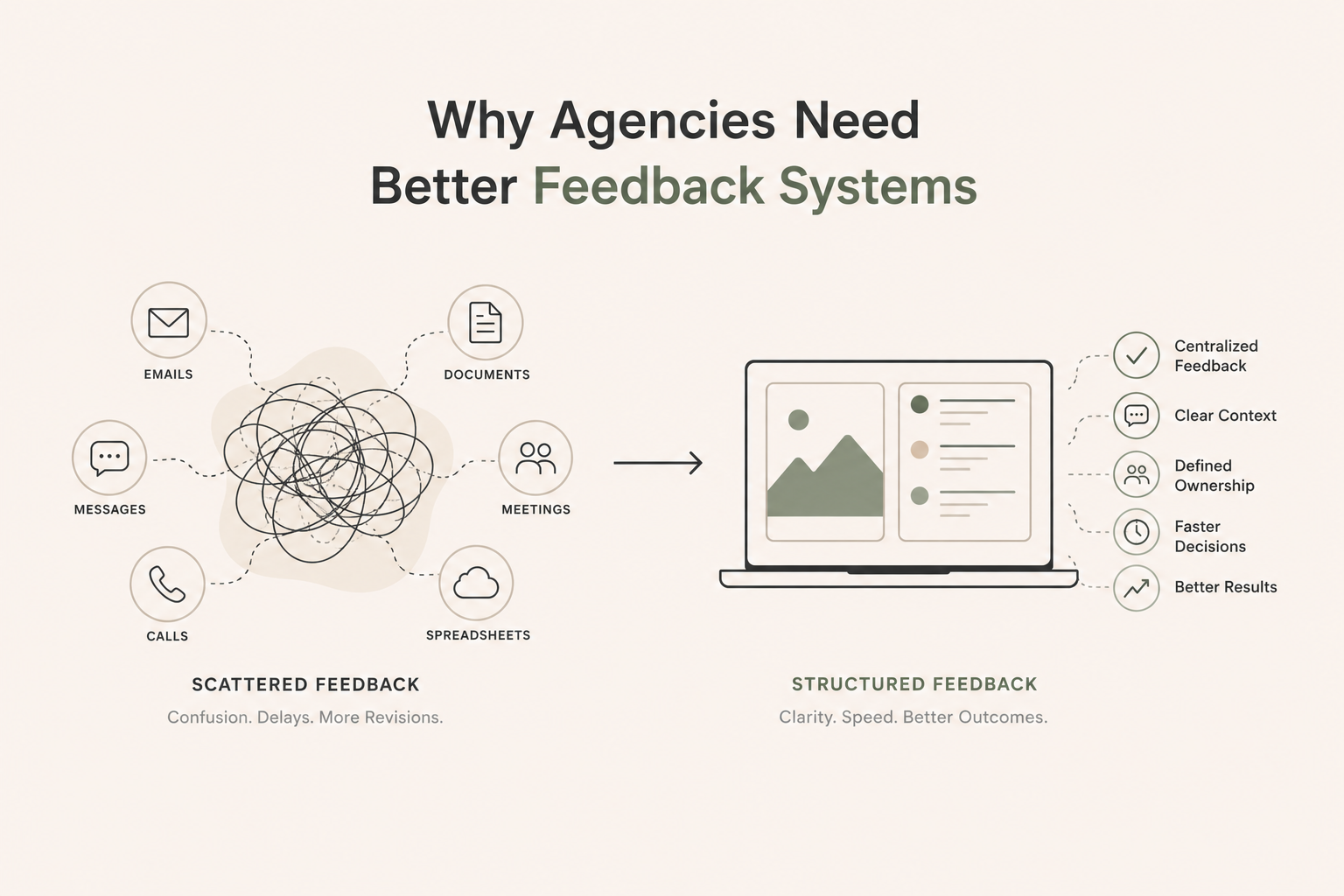
Many agencies still manage feedback across multiple channels.
Comments arrive through:
Email threads
WhatsApp messages
Slack conversations
Meetings
Phone calls
PDF annotations
At first, this feels manageable.
As project volume grows, it becomes chaos.
Teams spend more time finding feedback than implementing it.
The Hidden Cost of Fragmented Feedback
Poor feedback systems create problems that are often invisible until they become expensive.
Lost Comments
A stakeholder leaves feedback during a call.
Nobody documents it.
The change is forgotten.
The issue reappears later.
Contradictory Instructions
One stakeholder requests a change.
Another requests the opposite.
The team doesn't know which direction to follow.
Version Confusion
Feedback is provided on outdated files.
Teams revise the wrong version.
Progress slows.
Repeated Discussions
The same conversations happen multiple times because previous decisions aren't documented.
Why Feedback Delays Projects
Many agencies believe project delays are caused by design production.
In reality, delays often occur between stages.
The project waits for:
Reviews
Clarifications
Stakeholder responses
Approval decisions
Feedback becomes the bottleneck.
The work is ready.
The process is not.
The Difference Between Feedback and Decision-Making
One reason projects become stuck is that teams confuse feedback with decisions.
Feedback
Provides opinions, observations, and recommendations.
Decisions
Create direction and move the project forward.
Many projects collect feedback endlessly without reaching decisions.
This creates revision loops and approval delays.
A strong feedback system supports decision-making rather than replacing it.
Why Agencies Struggle as They Grow
A small agency can often operate through informal communication.
Everyone knows:
What changed
Who approved it
What needs attention
As teams scale, this becomes impossible.
More people create:
More comments
More stakeholders
More revisions
More communication
Without a structured feedback process, complexity grows faster than the agency's ability to manage it.
The Four Signs Your Feedback System Is Broken
1. Feedback Exists Everywhere
Comments are spread across multiple platforms.
Nobody knows where the latest instruction lives.
2. Revision Cycles Keep Growing
Projects require more rounds of changes than expected.
The team keeps revisiting the same issues.
3. Stakeholders Disagree
Feedback conflicts because expectations were never aligned.
4. Projects Feel Stuck
Work is complete, but reviews and approvals continue indefinitely.
What Great Feedback Systems Look Like
High-performing agencies treat feedback as a structured process.
Not a collection of comments.
Centralized Feedback
All comments exist in one place.
Everyone sees the same information.
Contextual Reviews
Feedback is attached directly to the work being reviewed.
There is no ambiguity.
Documented Decisions
Important decisions remain visible and searchable.
Teams avoid repeating discussions.
Clear Ownership
Everyone understands:
Who reviews
Who approves
Who implements feedback
Accountability improves.
Defined Review Stages
Creative reviews and execution reviews happen separately.
This reduces confusion and speeds up approvals.
How Better Feedback Improves Profitability
Many agency leaders view feedback as a communication issue.
It's also a financial issue.
Better feedback systems lead to:
Fewer Revision Cycles
Less rework means better margins.
Faster Project Delivery
Projects spend less time waiting.
Improved Team Productivity
Designers spend more time creating and less time managing communication.
Higher Client Satisfaction
Clients experience smoother collaboration and clearer decision-making.
Greater Scalability
The agency can handle more projects without increasing operational chaos.
The Role of Quality Control
Not all feedback should come from people.
Many comments involve issues that could have been caught earlier.
Examples include:
Alignment inconsistencies
Typography errors
Missing assets
Version mistakes
Spacing problems
Strong quality control systems reduce avoidable feedback and allow reviewers to focus on meaningful decisions rather than error correction.
Why Better Feedback Creates Better Creative Work
A common misconception is that more feedback produces better outcomes.
Not necessarily.
Better feedback produces better outcomes.
When teams receive:
Clear feedback
Relevant feedback
Timely feedback
Actionable feedback
they can focus on improving the work rather than deciphering instructions.
This protects both creativity and efficiency.
The Future of Creative Collaboration
As agencies grow increasingly distributed, feedback systems become more important than ever.
The agencies that scale successfully will not be the ones with the most meetings or the longest email threads.
They will be the ones with the clearest workflows.
The ability to collect, organize, review, and act on feedback efficiently is becoming a competitive advantage.
Conclusion
Every creative project depends on feedback.
But feedback without structure creates confusion.
Agencies that rely on scattered comments, undocumented decisions, and fragmented communication inevitably experience delays, revision loops, and operational inefficiencies.
The most successful agencies build systems that transform feedback into action.
Because feedback isn't just part of the creative process.
It is the process.
And the quality of that process often determines the quality of the final outcome.
Frequently asked questions
1. Why are feedback systems important for agencies?
Feedback systems help agencies manage reviews, revisions, approvals, and stakeholder communication efficiently. Strong systems reduce confusion, improve collaboration, and accelerate project delivery.
2. What problems do poor feedback systems create?
Poor feedback systems often lead to lost comments, conflicting instructions, excessive revision cycles, delayed approvals, version confusion, and reduced project profitability.
3. How can agencies improve their feedback process?
Agencies can improve feedback by centralizing comments, documenting decisions, defining review stages, assigning approval responsibilities, and using dedicated review and collaboration tools.
4. Why do revision cycles increase when feedback is unstructured?
When feedback is fragmented or unclear, teams struggle to identify priorities and make decisions. This often results in repeated changes, conflicting revisions, and longer project timelines.
5. How do feedback systems impact profitability?
Better feedback systems reduce rework, shorten project timelines, improve team productivity, increase client satisfaction, and help agencies maintain healthier profit margins.