Most agencies and in-house creative teams talk about burnout as if it’s mainly an emotional issue.
People are stressed.
People need better boundaries.
People should take time off.
Managers need to be more empathetic.
The team needs rest, motivation, and better culture.
None of that is wrong.
But it’s incomplete.
Because a lot of creative burnout is not caused by the existence of hard work. It’s caused by the way the work is structured.
Burnout happens when creative people spend too much of their time inside avoidable friction:
unclear briefs
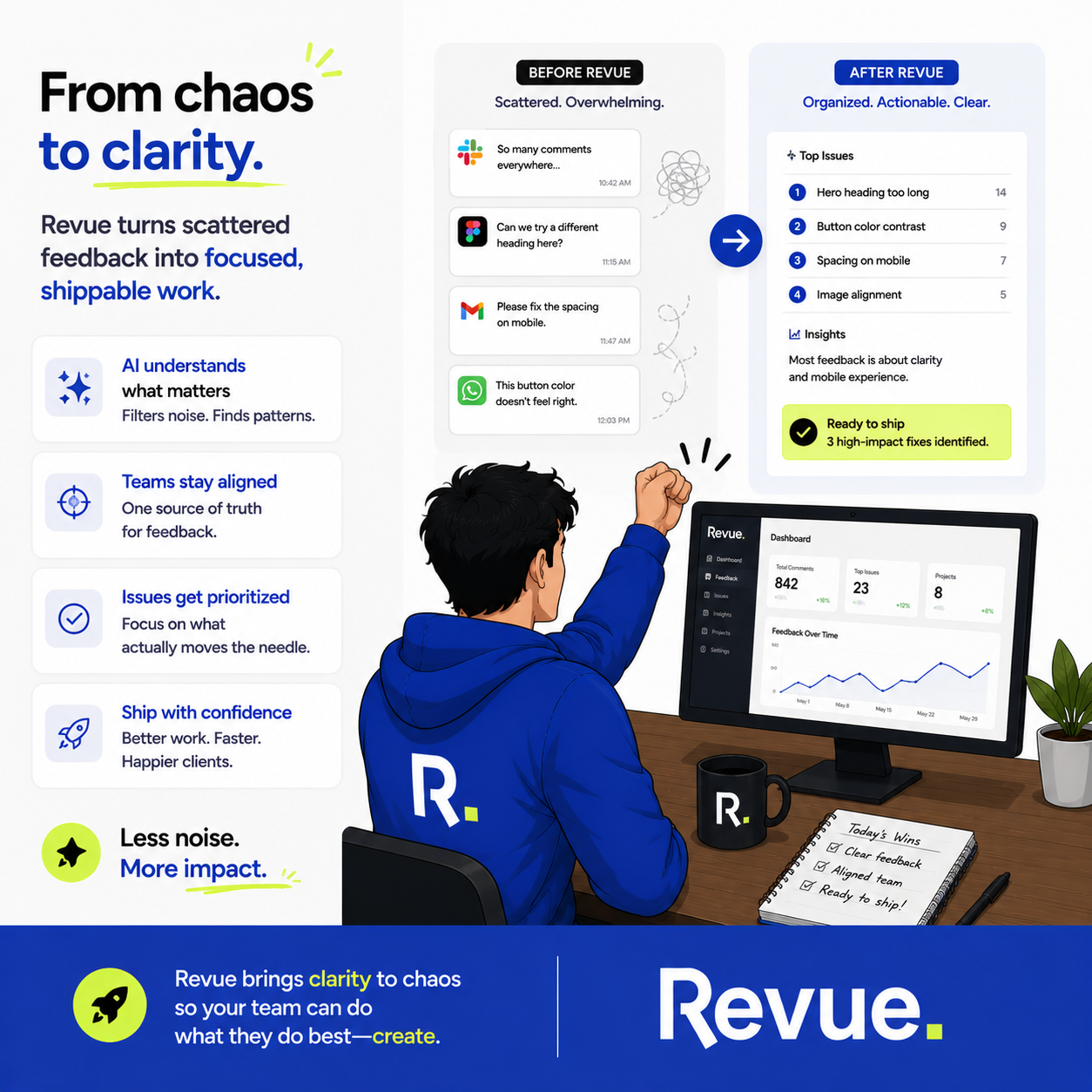
scattered feedback
last-minute changes
endless revision loops
weak approvals
version confusion
manual quality checking under pressure
rework that should never have existed in the first place
That friction matters because it doesn’t just make work harder. It makes work feel pointless, reactive, and psychologically draining.
A designer can handle intensity.
A strategist can handle pressure.
A creative lead can handle responsibility.
What burns people out faster is spending their energy on chaos that should have been prevented.
That’s the hard truth many agency leaders avoid: creative burnout is often the downstream effect of operational dysfunction.
If the workflow keeps forcing smart people to work in fragmented, interrupt-driven, low-control conditions, no amount of motivational talk is going to solve the real problem.
Burnout Is Not Just About Volume. It’s About Friction.
A lot of teams assume burnout comes mainly from having too much work.
Sometimes that’s true.
But volume alone does not explain why some teams can handle intense workloads without collapsing, while others burn out under lower output.
The missing variable is how much unnecessary friction sits around the work.
Two designers might both produce ten assets in a week.
One does it inside a reasonably clear system:
the brief is solid
feedback is centralized
approvals are predictable
versions are clear
quality checks happen in a defined way
revisions are controlled
The other does it inside a chaotic one:
the brief keeps shifting
comments are spread across Slack, email, and calls
approvals arrive late and conflict with each other
files reopen after “final” approval
a senior person keeps finding avoidable mistakes at the last minute
every project interrupts another project
The output count may look similar.
The experience of doing the work is completely different.
That’s why burnout is not just a workload issue. It’s an operational design issue.
Why Creative Work Becomes Burnout-Prone
Creative work already has some built-in pressure:
subjective feedback
deadlines
multiple stakeholders
changing business priorities
emotional attachment to output
the need to switch between strategic and executional thinking
That pressure is manageable when the workflow around the work provides some stability.
It becomes dangerous when the workflow adds instability on top of it.
Let’s break down the operational patterns that turn creative pressure into burnout.
1. Scattered Feedback Forces Constant Context Switching
This is one of the biggest burnout accelerators in creative teams.
Feedback arrives in Slack.
Then in email.
Then on a call.
Then through a screenshot.
Then someone sends a WhatsApp message with “just two more things.”
Then a stakeholder adds late comments after the team thought the work was already moving forward.
Now the designer, account manager, or creative lead has to reconstruct the project state manually:
Which comments are current?
Which feedback conflicts?
Which version is the client even looking at?
What has already been implemented?
What changed after the last review round?
This is cognitively expensive.
It breaks focus. It interrupts momentum. It forces people to spend mental energy on remembering and reconciling instead of creating.
Do that across multiple projects, every week, and burnout stops being surprising.
It becomes inevitable.
2. Endless Revision Loops Make Work Feel Never-Finished
Creative people can tolerate iteration. What they struggle with is meaningless repetition.
There’s a big difference.
A healthy revision loop improves the work. It sharpens thinking, refines execution, and moves the project toward completion.
A broken revision loop does the opposite:
work gets reopened after approval
comments arrive in fragments
multiple stakeholders weigh in late
the same concept gets reworked because no one aligned early enough
“small changes” keep expanding the scope of the job
the team never feels true closure
That has a serious psychological cost.
People stop feeling like they’re progressing.
They stop trusting approval milestones.
They stop believing the work is actually nearing done.
They start approaching every project with the expectation that it will come back again.
That is exhausting.
Burnout grows fast when people feel like effort doesn’t lead to completion—only to another round.
3. Weak Approval Systems Keep Teams in a Permanent State of Readiness
One of the most draining things in agency life is not knowing whether work is actually done.
The design is approved… unless leadership wants another look.
The copy is locked… unless the client reopens it tomorrow.
The campaign is final… unless someone forgot to show it to the marketing head.
The deck is sent… unless the founder wants “one more polish pass.”
That uncertainty keeps teams psychologically on call.
Even when the work is technically delivered, it doesn’t feel complete. People don’t mentally release it. They keep a part of their attention reserved for the likelihood that it’s coming back.
That creates chronic low-level tension.
Burnout isn’t only caused by long hours. It’s also caused by the inability to experience closure.
If approval systems are weak, creative teams don’t get closure. They get temporary pauses between interruptions.
4. Manual QA Turns Senior People Into Human Error Filters
Many agencies and creative teams still protect quality through one fragile system: responsible people manually checking everything before it goes out.
A founder rechecks the deck.
A senior designer scans for spacing issues.
A creative director spots the typo.
An account lead checks whether the latest copy was applied correctly across all versions.
That sounds responsible. It’s also a major burnout engine.
Because now senior people are not just doing strategic or creative leadership work. They’re also acting as human quality-control systems for the entire agency.
That creates two forms of burnout at once:
the senior people get overloaded by repetitive checking work
the rest of the team never feels fully trusted or operationally supported, because quality depends on someone else catching mistakes at the end
This is one of the clearest signs that burnout is operational, not personal. The workflow is requiring humans to carry a job the system should be helping with.
5. Bad Briefs Create Preventable Rework
A bad brief doesn’t just slow a project down. It burns people out.
When the brief is vague, incomplete, or strategically weak, the creative team pays for it later:
wrong assumptions get built into the work
the first concept misses the mark
feedback becomes more subjective because the target was never clear
internal stakeholders reinterpret the ask midway through the project
the team ends up revising work that should never have been made in that form
That is deeply demoralizing.
Creative people can handle difficult work. What drains them is putting serious effort into output that collapses because the input was weak.
When that happens repeatedly, the team stops feeling challenged in a healthy way. They start feeling set up to fail.
6. Last-Minute Changes Destroy Recovery Time
Burnout is not just about how much work exists. It’s also about whether people can recover between bursts of intensity.
Last-minute changes destroy that recovery.
A designer finishes one urgent project and is about to shift focus. Then an approved campaign comes back with three more changes.
An account manager finally clears the day’s approvals and then a client reopens yesterday’s deck.
A creative lead plans tomorrow around current priorities and then a stakeholder drops an urgent change request at 7:30 PM.
Now the day doesn’t end cleanly. The week doesn’t reset cleanly. The team doesn’t get psychological distance from the work.
Instead, everything feels like it can break open again at any moment.
That is one of the fastest ways to create chronic exhaustion.
7. Constant Operational Rescue Makes High Performers Hate the Work
In many agencies, the most responsible people become the cleanup layer for everything.
They know the client context.
They know which feedback matters.
They catch inconsistencies.
They calm down projects that are going off the rails.
They fix the brief gaps.
They notice when a file is outdated.
They step in when quality slips.
These people often look high-performing from the outside.
Internally, they are carrying too much invisible load.
Over time, that kind of operational rescue work becomes emotionally corrosive. It turns strong creative leaders into firefighters. They spend less time doing the work they’re actually good at and more time protecting the business from preventable mess.
That’s not sustainable. It’s one of the clearest routes to burnout and attrition.
8. Teams Lose Motivation When Effort Feels Wasted
This is the emotional center of the whole problem.
Burnout grows faster when people believe their effort is being wasted.
Not because the work is hard.
Because the system keeps nullifying the effort.
The team works late on a concept, then the brief changes.
They finish a clean deck, then the wrong version gets sent.
They adapt twenty assets, then a last-minute copy change forces half of them to be reopened.
They get approval, then another stakeholder re-enters the process and resets the conversation.
That pattern teaches people something dangerous:
your effort does not reliably move the work forward.
Once that belief settles in, motivation drops fast.
People become less energized, less patient, less invested, and more emotionally detached from the work. That’s not because they suddenly became weak. It’s because the system trained them to expect waste.
Why Burnout Is a Leadership and Operations Issue
If burnout is driven by scattered feedback, weak approvals, version confusion, poor briefing, late changes, and manual QA overload, then the response cannot just be “take care of your people.”
Of course you should take care of your people.
But if you want to reduce burnout meaningfully, leadership has to treat the workflow itself as part of the problem.
That means asking harder questions:
Where is unnecessary friction coming from?
Why are the same projects reopening repeatedly?
Why do approvals feel unstable?
Why are senior people still acting as manual QA layers?
Why is feedback still scattered across tools and channels?
Why do late changes keep breaking the week?
Why do people keep spending energy on avoidable cleanup?
These are not HR questions. They are operational questions.
And until they are treated that way, burnout will keep returning no matter how many wellness conversations the agency has.
What Agencies Can Do to Reduce Burnout Operationally
If you want a healthier creative team, you need a healthier operating system.
That means building more control around the exact parts of the workflow that drain people the most.
1. Centralize Feedback
Reduce context switching by making feedback visible in one place attached to the work.
2. Tighten Approval Gates
Make “approved” actually mean something. Define who signs off, when, and what happens if work is reopened.
3. Improve Brief Quality
A stronger brief reduces avoidable revision cycles and wasted creative effort.
4. Build Real Version Clarity
People should not have to spend mental energy figuring out what file is current or what changed.
5. Add QA Structure Instead of Relying on Heroics
Stop making senior people the only safety net for preventable errors.
6. Track Burnout as a Workflow Signal
If the same people are always overloaded, always rescuing, always context-switching, or always stuck in revision loops, that’s not just a staffing issue. It’s a system issue.
7. Reduce Reopened Work
The more often approved work comes back, the less psychological closure the team gets. That matters more than most leaders realize.
Where Revue Fits In
Revue is relevant here because a huge amount of burnout in creative teams comes from the review-and-revision layer—the part of the workflow where chaos compounds fastest.
That’s where:
feedback gets scattered
comments conflict or arrive late
versions get confusing
revisions reopen work repeatedly
rushed review cycles increase error risk
people lose time and energy in preventable coordination
Revue helps teams create more structure around that layer by improving:
centralized annotations and feedback
visibility across revisions and approvals
quality checks for static creative work
version clarity during review
the path from draft to final sign-off
That doesn’t solve every cause of burnout. But it directly targets one of the most operationally exhausting parts of creative work.
Final Thought: Burnout Is Often a Signal That the System Is Failing the People
This is the part leaders need to hear clearly.
When creative teams burn out, the answer is not always “they need to toughen up,” “they need better boundaries,” or even “they need fewer projects.”
Sometimes what they need is a workflow that stops wasting their energy.
Because burnout is not only about stress. It’s about the repeated experience of spending talent, attention, and care inside a system that creates too much preventable friction.
If your agency wants to keep good creative people, don’t just ask how to motivate them better.
Ask how much of their exhaustion is being manufactured by the way the work currently runs.
That question is where the real fix starts.
Frequently asked questions
1. Why is creative burnout considered an operational problem?
Because burnout is often caused by broken workflows—scattered feedback, endless revisions, unclear approvals, version confusion, poor briefs, and manual QA overload—not just heavy workloads.
2. Can creative burnout happen even if the team isn’t overloaded with work?
Yes. Burnout can come from constant context switching, rework, approval chaos, and the feeling that effort is being wasted, even when output volume is not extreme.
3. How do scattered feedback and revision chaos contribute to burnout?
They force people to reconstruct project context repeatedly, interrupt focus, reopen work after it feels finished, and spend mental energy on coordination instead of creative thinking.
4. Why do weak approval systems make burnout worse?
Because teams never get real closure. If “approved” work can always come back unpredictably, people stay psychologically on call and never fully release projects.
5. How does manual quality control affect burnout in agencies?
It overloads senior people with repetitive checking work and makes the workflow dependent on human vigilance instead of system support, which increases stress and fatigue.
6. What operational fixes can reduce creative burnout?
Clearer briefs, centralized feedback, stronger approval gates, better version control, more structured QA, and fewer reopened projects can all reduce burnout-causing friction.
7. Is burnout a culture problem or a workflow problem?
It can be both, but many teams treat it only as a culture issue when the bigger driver is often workflow design—how work moves, gets reviewed, gets revised, and gets approved.