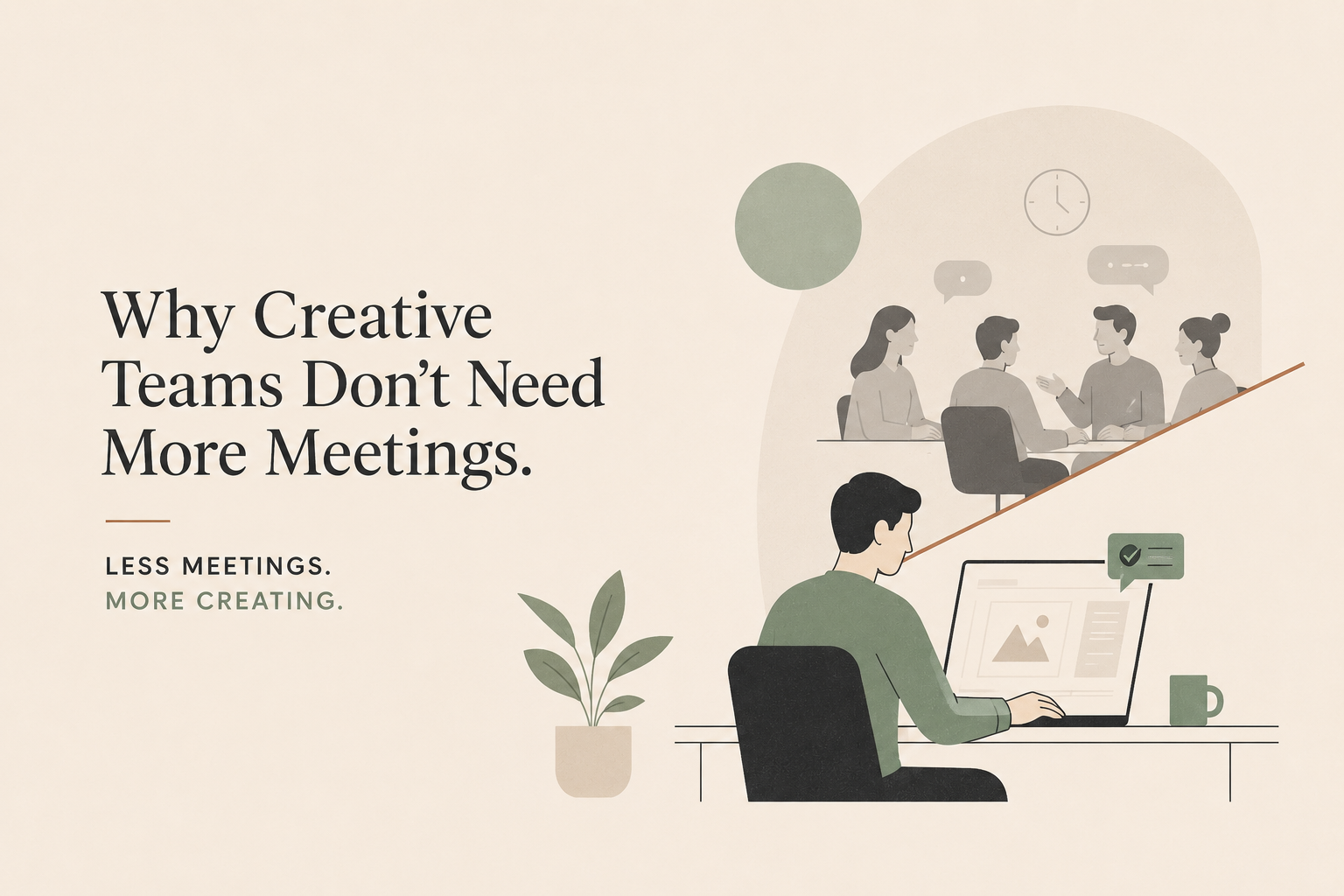
For many agencies and in-house creative teams, the default response to any problem is simple:
"Let's schedule a meeting."
Missed deadline?
Meeting.
Unclear feedback?
Meeting.
Design revisions?
Meeting.
Communication issue?
Another meeting.
While meetings are intended to improve collaboration, they often become the very thing preventing productive work from happening.
The truth is that most creative teams don't have a communication problem.
They have a workflow problem.
And adding more meetings rarely fixes broken workflows.
The Hidden Cost of Creative Meetings
Meetings feel productive because people are talking.
But talking and creating are not the same thing.
Every meeting interrupts:
Deep design work
Creative thinking
Problem-solving
Production momentum
Focused execution
A designer who loses two hours to meetings doesn't just lose two hours.
They often lose the mental state required to produce high-quality creative work.
For creative professionals, context switching is one of the biggest productivity killers.
Why Meetings Multiply as Teams Grow
As agencies expand, communication becomes more complex.
More stakeholders create:
More opinions
More approval layers
More status updates
More clarification requests
Instead of improving processes, organizations often compensate by scheduling additional meetings.
The result is predictable:
Longer project timelines
Slower decision-making
Reduced creative output
Increased frustration
Growth should improve efficiency, not increase communication overhead.
The Real Problem: Information Lives in Conversations
Many creative teams rely heavily on verbal discussions.
Important decisions get buried inside:
Video calls
Internal meetings
Slack conversations
Client calls
Days later, nobody remembers:
What was approved
What changed
Who made the decision
Why the revision was requested
This creates confusion, repeated discussions, and unnecessary review cycles.
What Creative Teams Need Instead
The highest-performing creative teams don't eliminate communication.
They make communication structured.
1. Centralized Feedback
Feedback should live alongside the work.
Instead of discussing designs across emails, calls, and messages, teams should capture comments directly on creative assets.
Benefits include:
Clear context
Faster revisions
Reduced misunderstandings
Better accountability
2. Documented Decisions
Every important decision should be visible and searchable.
When decisions are documented:
New team members onboard faster
Repeated discussions decrease
Project history remains accessible
Client communication becomes clearer
Documentation scales better than meetings.
3. Asynchronous Collaboration
Not every discussion requires real-time participation.
Many creative reviews can happen asynchronously.
Examples include:
Design feedback
Copy reviews
Approval requests
Quality checks
Project updates
This allows designers to remain focused while stakeholders review work on their own schedule.
4. Better Quality Control
Many meetings exist solely because issues were discovered too late.
Examples:
Typography inconsistencies
Alignment problems
Missing assets
Incorrect versions
Production errors
Improved design quality control reduces the need for lengthy review discussions and revision meetings.
Preventing mistakes is far more efficient than discussing them afterward.
The Meeting Trap in Creative Agencies
Many agencies believe communication improves when everyone is involved.
In reality, involving too many people often creates:
Conflicting feedback
Design-by-committee decisions
Endless revisions
Approval bottlenecks
More participants rarely create better creative outcomes.
Clear ownership does.
The best creative teams know exactly:
Who provides feedback
Who approves work
Who makes final decisions
This eliminates unnecessary discussions.
When Meetings Actually Make Sense
Not all meetings are bad.
The problem is using meetings as a substitute for process.
Meetings are valuable when:
Defining project goals
Running creative workshops
Solving complex strategic challenges
Building client relationships
Conducting retrospectives
Meetings become wasteful when they are used for:
Status updates
Approval tracking
Feedback collection
Finding information
Clarifying undocumented decisions
These tasks can often be handled more efficiently through structured workflows.
How Modern Creative Teams Work
Leading agencies and design teams are shifting toward systems that reduce communication friction.
Their workflow typically includes:
Centralized project management
Structured design reviews
Documented decisions
Asynchronous feedback
Automated quality checks
Clear approval workflows
As a result, teams spend less time discussing work and more time creating it.
Why Fewer Meetings Often Lead to Better Creative Work
Creativity requires uninterrupted thinking.
The best ideas rarely emerge during back-to-back status calls.
They emerge when designers, writers, strategists, and creative directors have space to think deeply.
Reducing unnecessary meetings creates:
More focus time
Faster execution
Better design quality
Improved team morale
Higher productivity
The goal is not less communication.
The goal is more effective communication.
Conclusion
Creative teams don't need more meetings.
They need better systems.
Most communication challenges stem from fragmented feedback, undocumented decisions, scattered conversations, and inefficient review processes.
When agencies implement structured workflows, centralized feedback systems, and effective quality control processes, meetings naturally decrease while productivity increases.
The strongest creative teams aren't the ones that communicate the most.
They're the ones that communicate with the least friction.
Frequently asked questions
1. Why do creative teams spend so much time in meetings?
Creative teams often use meetings to compensate for unclear workflows, scattered feedback, and poor documentation. As projects become more complex, meetings become the default solution, even when better systems could solve the problem more efficiently.
2. What is asynchronous collaboration in creative work?
Asynchronous collaboration allows team members to review, comment, and approve work without being present at the same time. This reduces interruptions and gives creatives more uninterrupted focus time while maintaining effective communication.
3. How can agencies reduce unnecessary meetings?
Agencies can reduce meetings by centralizing feedback, documenting decisions, using project management systems, implementing structured approval processes, and conducting design reviews directly on creative assets rather than through calls.
4. Do fewer meetings improve creative productivity?
In most cases, yes. Fewer unnecessary meetings reduce context switching, increase focus time, and allow creative professionals to spend more time producing high-quality work rather than discussing it.
5. What tools help creative teams collaborate without meetings?
Creative teams often use design review tools, project management platforms, proofing software, collaboration tools, and quality control systems to streamline communication and reduce reliance on meetings.