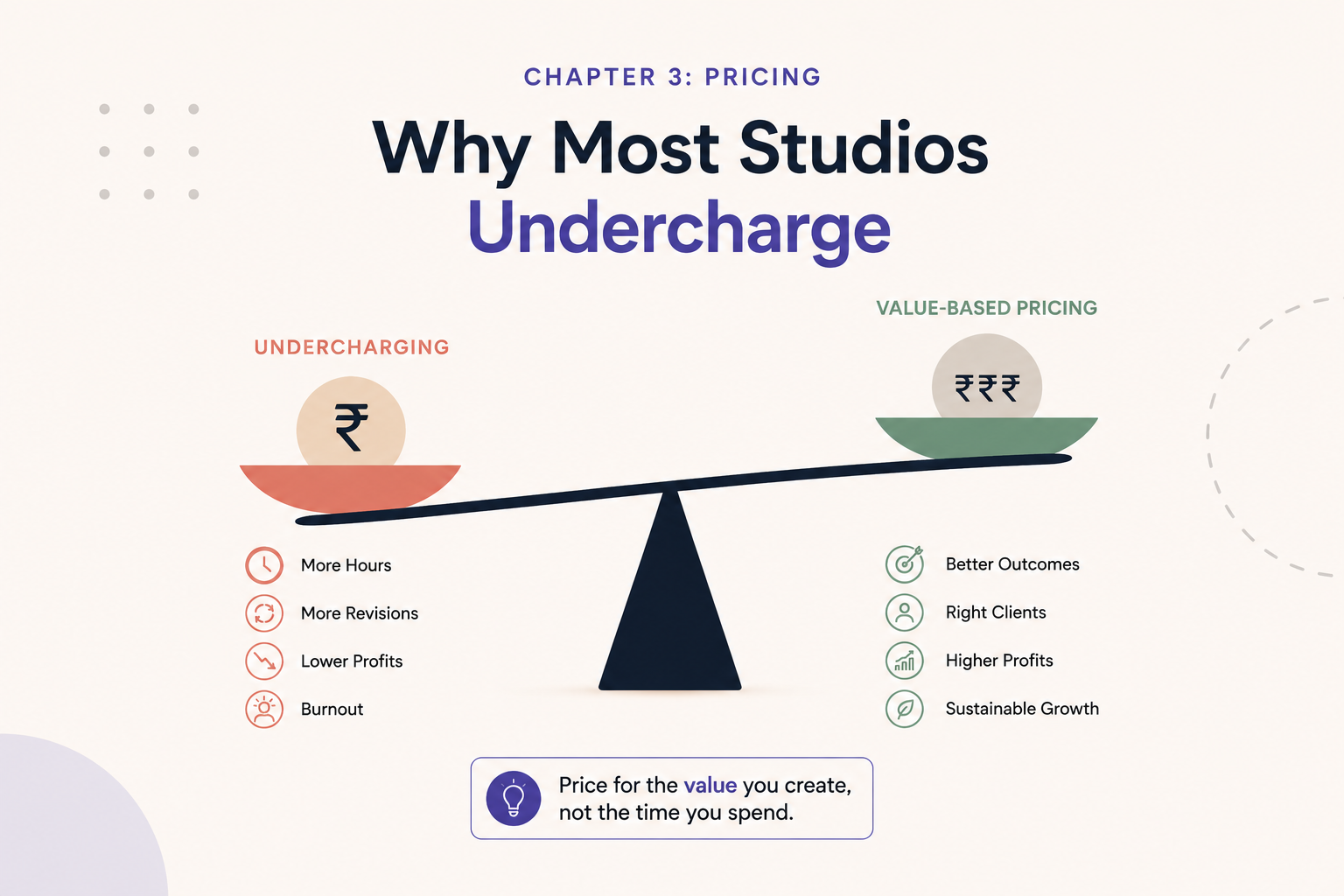
The Biggest Threat to a Design Studio Isn't Competition
Most studio owners believe their biggest challenge is:
Finding clients
Hiring talent
Winning projects
Standing out from competitors
In reality, the biggest threat is often much simpler:
They charge too little.
Not by 5%.
Not by 10%.
In many cases, by 30–70%.
The result?
Constant cash flow pressure
Overworked teams
Difficulty hiring senior talent
Low profitability
Slow growth
Ironically, many studios work harder every year while becoming less financially healthy.
The root cause is usually pricing.
Why Most Studios Undercharge
Underpricing rarely happens because studio owners can't do math.
It happens because pricing is emotional.
When agencies price projects, they're not just calculating costs.
They're confronting:
Fear of rejection
Fear of losing clients
Fear of competition
Fear of appearing expensive
Fear of uncertainty
Most pricing decisions are psychological before they are financial.
The Freelancer Habit That Never Goes Away
Many studio founders start as freelancers.
As freelancers, the thinking is simple:
"If I charge less, I'll win more work."
Initially, this strategy works.
But when that freelancer becomes a studio owner, the same mindset becomes dangerous.
Because studios have costs freelancers don't:
Salaries
Software
Operations
Project management
Business development
Quality control
Administration
Yet many agencies continue pricing like solo practitioners.
The business grows.
The pricing doesn't.
The "More Clients" Trap
When revenue feels uncertain, many studios respond by chasing more projects.
This creates a cycle:
Prices remain low
More projects are needed
Workload increases
Team becomes overloaded
Quality declines
Profitability remains weak
The studio gets busier.
But not healthier.
Volume becomes a substitute for profitability.
Why Clients Rarely Choose the Cheapest Option
Many agencies assume lower prices increase sales.
Research consistently shows that's not always true.
In creative services, buyers often associate higher pricing with:
Expertise
Reliability
Professionalism
Strategic thinking
Reduced risk
When pricing is too low, clients may wonder:
Why are they so cheap?
What am I missing?
Are they experienced enough?
Will they disappear midway?
Low pricing can actually reduce trust.
The Hourly Pricing Problem
One of the biggest reasons studios undercharge is reliance on hourly thinking.
Clients don't buy hours.
They buy outcomes.
Consider two scenarios:
Agency A
Charges ₹1,50,000 for a rebranding project.
Agency B
Charges ₹5,00,000 for the same project.
If the rebrand helps generate ₹2 crore in additional revenue, neither client cares how many hours were spent.
They care about results.
The value delivered dramatically outweighs the time invested.
Why Time-Based Pricing Punishes Expertise
Imagine two designers.
Junior Designer
Takes 20 hours to solve a problem.
Senior Designer
Takes 5 hours to solve the same problem.
With hourly pricing:
The junior designer earns more.
This creates a strange incentive.
The more experienced you become, the less you can bill.
Expertise gets penalized.
Efficiency becomes a liability.
The Hidden Cost of Low Pricing
Underpricing affects far more than revenue.
It Attracts the Wrong Clients
Price-sensitive clients often:
Request more revisions
Negotiate aggressively
Delay decisions
Question recommendations
Low prices can attract high-maintenance relationships.
It Creates Revision Overload
When projects are underpriced, teams cannot absorb endless feedback cycles profitably.
Every revision reduces margins.
This is why agencies increasingly focus on structured review and approval processes.
Without efficient feedback management, underpriced projects become financially unsustainable.
It Limits Hiring
Great designers aren't cheap.
Neither are:
Strategists
Developers
Account managers
Creative directors
When pricing remains low, hiring becomes difficult.
Growth stalls.
It Prevents Innovation
Studios operating on thin margins rarely have time for:
Research
Process improvements
Product development
Team training
New service offerings
Every hour becomes billable survival work.
Why Agencies Struggle to Raise Prices
Even when studio owners know they're undercharging, raising prices feels uncomfortable.
Why?
Because pricing feels personal.
When clients reject a proposal, many founders interpret it as:
"You're not worth that much."
In reality, pricing objections are usually about:
Budget
Timing
Priorities
Internal constraints
Not your value.
The Difference Between Cost and Value
Many studios calculate pricing based on cost.
Example:
Team cost = ₹50,000
Margin = ₹25,000
Project price = ₹75,000
The problem?
The client doesn't care about your costs.
They care about outcomes.
If the project helps:
Increase conversions
Improve retention
Strengthen branding
Accelerate growth
Its value may be many times higher than your internal cost.
The Shift From Design Vendor to Strategic Partner
Underpriced agencies are often viewed as vendors.
Premium-priced agencies are often viewed as partners.
The difference is not always quality.
It's positioning.
Vendors execute requests.
Partners solve business problems.
Partners command higher fees because they influence outcomes.
Pricing and Client Perception
Pricing communicates signals.
Every proposal answers questions clients may never ask directly:
How experienced are you?
How confident are you?
How strategic are you?
How much risk are you removing?
Price is part of branding.
Whether agencies realize it or not.
The Profitability Equation Most Studios Ignore
Imagine:
Studio A
20 projects/month
₹50,000 average project value
Revenue: ₹10,00,000
Studio B
10 projects/month
₹1,25,000 average project value
Revenue: ₹12,50,000
Studio B serves fewer clients.
Manages fewer revisions.
Runs fewer meetings.
Creates less operational stress.
Yet earns more.
The goal isn't maximum projects.
The goal is maximum profitable projects.
How Better Processes Support Higher Pricing
Premium pricing requires premium execution.
Clients paying higher fees expect:
Professional communication
Clear approvals
Organized workflows
Reliable delivery
Transparency
This is why growing agencies invest in systems.
Platforms such as Revue help creative teams streamline review cycles, centralize feedback, improve quality control, and create a more professional client experience.
Better operations strengthen pricing power.
How Studios Can Stop Undercharging
1. Calculate True Costs
Include:
Salaries
Overheads
Software
Management time
Business development
Non-billable work
Most agencies underestimate actual delivery costs.
2. Price Outcomes, Not Hours
Focus conversations on:
Business impact
Goals achieved
Problems solved
Not time spent.
3. Reduce Revision Waste
Every unnecessary revision reduces profit.
Create structured review processes.
Define approval stages.
Align stakeholders early.
4. Package Expertise
Clients buy certainty.
Create service packages around outcomes rather than deliverables.
5. Raise Prices Gradually
Not every increase needs to be dramatic.
Consistent incremental increases often outperform occasional large jumps.
What Successful Studios Understand
The highest-performing agencies eventually discover a critical truth:
Clients rarely pay for design files.
They pay for:
Confidence
Clarity
Expertise
Problem-solving
Reduced risk
When studios understand this, pricing conversations change completely.
They stop selling deliverables.
They start selling outcomes.
Conclusion
Most studios don't struggle because they lack talent.
They struggle because their pricing doesn't reflect their value.
Undercharging creates a chain reaction:
Lower profits
More projects
More revisions
More stress
Slower growth
The agencies that scale successfully aren't always the most creative.
They're often the ones that understand the relationship between value, pricing, and profitability.
Because sustainable growth doesn't come from working harder.
It comes from charging appropriately for the results you create.
Frequently asked questions
Why do design studios undercharge?
Most studios undercharge due to fear of losing clients, competition, rejection, and reliance on outdated hourly pricing models.
Is hourly pricing bad for agencies?
Not always, but hourly pricing often limits profitability because it ties revenue to time instead of value delivered.
How can agencies increase pricing without losing clients?
By focusing on outcomes, improving positioning, strengthening processes, and demonstrating business impact rather than deliverables.
Why do low-paying clients request more revisions?
Price-sensitive clients often seek maximum perceived value, leading to more feedback cycles, negotiations, and revision requests.
What pricing model works best for creative agencies?
Value-based pricing is generally more scalable because it aligns fees with business outcomes rather than hours worked.